
From petrodollars to solar power: India’s energy transition in a changing global economy

GUEST COLUMN

The global energy system is entering a new phase. For decades, oil and gas were at the centre of the world economy. Countries with large fossil-fuel reserves gained enormous economic and geopolitical influence. Oil was not just a source of energy; it also became closely connected with international trade, finance and global political power.
Today, however, that system is beginning to change. The rapid growth of solar power, wind energy, batteries and other clean technologies is creating a new energy landscape. The transition is not happening overnight, and oil and gas will remain important for years to come. But the direction of the global economy is becoming increasingly clear: energy security is gradually being linked with renewable energy, technology and control over supply chains.
The USA and European countries are facing growing pressure to manage energy prices, inflation, industrial competitiveness and energy security. Germany and Spain have significantly expanded their renewable-energy capacity. In 2025, the European Union added nearly 70 GW of solar PV capacity. For these countries, renewable energy is no longer simply an environmental issue. It is increasingly a question of economic security. When countries depend heavily on imported oil and gas, sudden changes in international energy prices can affect households, businesses and industries. Greater use of domestic renewable energy can reduce some of this exposure. Solar power, in particular, has become increasingly attractive because the cost of solar technology has fallen sharply over the past decade. Thus, the global energy transition should not be understood only as a fight against climate change. It is also becoming a competition over technology, investment, manufacturing and economic power.
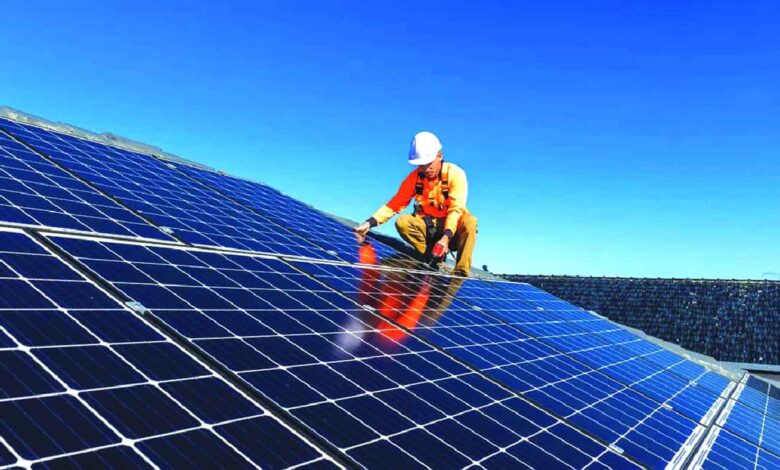
India is becoming an important part of this transformation. It has enormous energy requirements due to its large population, expanding industries, urbanisation and a growing middle class. At the same time, India wants to reduce its dependence on imported fossil fuels and strengthen its long-term energy security. Solar energy provides an important opportunity.
Our solar capacity has grown dramatically over the past decade. According to the Ministry of New and Renewable Energy, India’s installed solar capacity reached 162.15 GW by June 30, 2026. This growth represents a major change in India’s energy landscape. In June 2025, non-fossil sources crossed 50% of the country’s installed electricity capacity, more than five years ahead of the original 2030 NDC milestone. India continues to work toward its target of 500 GW of non-fossil electricity capacity by 2030. These numbers show that India’s renewable-energy transition is already taking place on a very large scale.
The importance of solar power goes far beyond electricity generation. A strong solar sector can create jobs, support manufacturing, encourage entrepreneurship and reduce exposure to international fossil-fuel price shocks. This means that the solar transition can become a source of employment and economic development, particularly if India succeeds in building a strong domestic supply chain. The government’s PM-KUSUM scheme is another example of how solar energy is being connected with rural economic activity. The scheme aims to expand decentralised renewable-energy generation, install standalone solar agricultural pumps and solarise grid-connected agricultural pumps. If implemented effectively, such programmes can create a link between clean energy and rural economic development. In this sense, solar energy is becoming part of India’s broader development strategy.
India’s solar opportunity also comes with a major challenge. Solar panels may produce clean electricity, but the manufacturing process depends on a complex international supply chain. China currently dominates several stages of global solar PV manufacturing. According to the International Energy Agency, China’s share of manufacturing capacity across major solar PV stages has exceeded 80%. The concentration is even more significant in some parts of the supply chain. The IEA has noted that China’s share of global wafer manufacturing capacity is above 95%. This creates an interesting contradiction. Countries may reduce their dependence on imported oil and gas by shifting towards solar power, but they could become dependent on a different set of international supply chains for solar panels, cells, wafers and other components.
Therefore, the future energy race is not simply about who produces the most electricity. It is also about who controls the technology and manufacturing needed to produce that electricity.
India is trying to build a stronger domestic solar-manufacturing ecosystem and reduce dependence on imported components. One important initiative is the Production Linked Incentive scheme for high-efficiency solar PV modules. The scheme has an outlay of Rs 24,000 crore and aims to build large-scale manufacturing capacity for high-efficiency solar PV modules in India. If India can manufacture the equipment, develop the technology, train skilled workers and build competitive companies, the benefits will be much greater. India has also introduced the Approved List of Models and Manufacturers, or ALMM, to strengthen quality and domestic manufacturing requirements in government-supported solar projects. These policies indicate that India does not want to remain only a large consumer of solar technology. It wants to become an important producer as well.
Earlier, countries competed for oil reserves, gas supplies and access to fossil-fuel markets. In the emerging energy economy, countries will increasingly compete for solar manufacturing, batteries, critical minerals, technology, skilled labour and supply chains. This means the clean-energy transition is also becoming an industrial-policy competition. The countries that succeed will not necessarily be those that simply install the largest number of solar panels. They will be those that can build strong domestic industries around renewable energy.
The changing role of BRICS adds an important dimension to the transformation of the global energy economy and has significant implications for India’s solar energy policy. BRICS countries collectively represent a significant share of the world’s population, energy demand, natural resources and emerging markets. Their growing economic cooperation could influence future trade, investment and energy relationships. India’s engagement with BRICS can contribute to the diversification of its energy partnerships and reduce excessive dependence on traditional western markets and institutions. In the solar sector, this is particularly relevant because the development of solar energy depends not only on domestic generation capacity but also on access to photovoltaic modules, critical minerals, battery technologies, energy-storage systems, finance and advanced manufacturing capabilities. Greater cooperation among BRICS economies could therefore support India in developing more diversified and resilient solar-energy supply chains.
However, it would be too simple to describe the global transition as a straightforward shift from the west to the east. The major global economy remains deeply interconnected through trade, technology, finance and supply chains. Therefore, India’s solar-energy policy is likely to follow a strategy of strategic diversification rather than exclusive alignment with any particular geopolitical bloc.
It would be premature to say that oil has become irrelevant. Oil remains essential for transportation, petrochemicals, aviation, manufacturing and many other sectors. Global economic growth will continue to depend on fossil fuels for some time. But the nature of energy dependence is changing. The world is gradually moving toward a system where several energy sources operate together. Oil and gas will remain important, but solar, wind, hydro, batteries, hydrogen and other technologies are becoming increasingly important as well. Therefore, the future may not be an immediate transition from “oil to solar.” It is more likely to be a gradual transformation toward a more diversified energy system.
The old economic system was heavily shaped by oil and gas. The emerging system will be shaped by a combination of renewable energy, technology, manufacturing and supply chains. India has already made significant progress. But the next stage will be more difficult. India will need to address energy storage, grid integration, land availability, financing, technology, manufacturing, critical minerals and workforce development.
Most importantly, India will need to ensure that the clean-energy transition creates benefits beyond electricity generation. It should create jobs, businesses, innovation, rural opportunities and stronger domestic industries. The global energy race is increasingly about who can produce affordable clean energy, who controls the technology, who manufactures the equipment and who has the strongest supply chains. That is why the transition from petrodollars to solar power is not just an energy story.
(Semwal is head of Political Science department in HNB Garhwal University, Sharma is a research scholar in the department; views expressed are personal)