

GUEST COLUMN
 Kripa Nautiyal
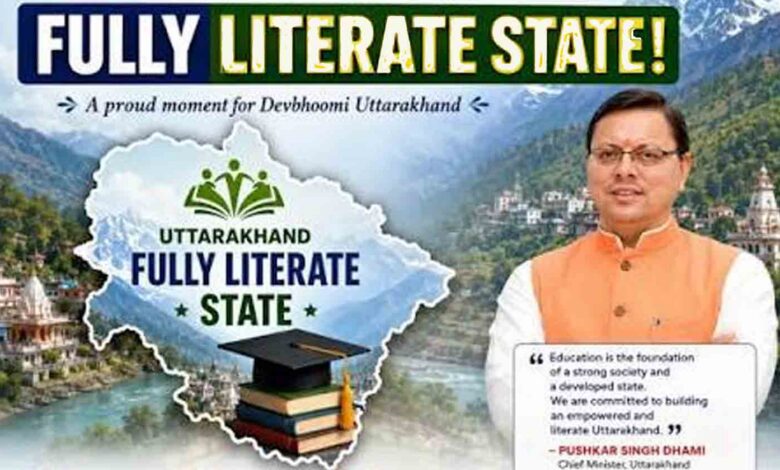
On July 8, 2026, the Uttarakhand government issued a formal notification declaring the State fully literate under the ULLAS (Understanding Lifelong Learning for All in Society) scheme, aligned with the National Education Policy (NEP) 2020. The Secretary of the School Education and Literacy department signed off on what will likely be celebrated as a landmark achievement. Press releases, congratulatory statements from ministers, and favorable comparisons with other “fully literate” states are all but guaranteed to flood public discourse.
But before the state indulges in self-congratulation, it is worth asking what this declaration actually measures—and what it conveniently leaves out. A “fully literate” tag, under government criteria, signifies that a high percentage of the adult population can read, write, and perform basic arithmetic. It says nothing about the quality of schooling children currently receive, nothing about whether that schooling is accessible where people live, and nothing about why, year after year, families in Uttarakhand’s mountain districts continue to pack up and leave for the plains. Literacy is merely a floor, not a ceiling. Treating it as the finish line risks papering over a crumbling public education system that is failing precisely the population it should be serving.
A national pattern of eroding public confidence
A recent analysis of UDISE+ data offers a sobering national backdrop to Uttarakhand’s celebration. Government schools across India lost close to 86 lakh students between 2023-24 and 2025-26, even as private unaided schools gained roughly 88 lakh students in the same period. Enrolment in government institutions fell from 12.8 crore to 11.9 crore, while private school enrolment rose from 9 crore to 9.9 crore. This massive shift is a clear signal that parents, wherever they have the financial means, are voting with their feet against government schooling. Alarmingly, this exodus is happening even as physical access indicators—such as pupil-teacher ratios, digital infrastructure, drinking water, and separate toilets—have genuinely improved nationwide. The crucial lesson here is that infrastructure gains and enrolment numbers can move in opposite directions from public confidence. As noted educationist has pointed out that the education system has bifurcated into two distinct worlds: the public and the private. Those segments of society that need quality education the most are left relying on government schools out of absolute compulsion, not choice. Parents are walking away because they no longer trust the credibility and quality of the public system to guarantee actual learning.
Out-migration and the collapsing village school
In Uttarakhand’s hills, this national crisis manifests as a localised tragedy. Here, families aren’t just switching schools within the same town—they are abandoning the hills entirely. The state’s Rural Development and Migration Prevention Commission, alongside independent research by me, has repeatedly documented that the “push factors” behind out-migration extend far beyond employment. Poor access to quality education and healthcare rank alongside livelihood concerns as leading drivers of regional depopulation.
This creates a destructive, self-perpetuating cycle:
· The exodus: Young families leave mountain villages for plains towns in search of better schooling.
· The structural collapse: As children leave, local village schools lose their enrolment base.
· The policy reflex: The state responds by merging under-enrolled institutions or reducing them to single-teacher schools.
· The final abandonment: Learning quality deteriorates further, giving the remaining families even less reason to stay.
Districts like Almora and Pauri have witnessed negative population growth for years. Even from Jaunsar Bawar area people have started out migrating due to poor education standard in the area. The state now harbours well around 2,000 “ghost villages”—settlements entirely abandoned because residents saw no viable future for their children.
A bare literacy statistic erases this grim reality. A parent who can sign their name is counted as literate. However, that same parent, watching their child sit in a dilapidated two-room school where one overworked teacher handles five grades simultaneously, faces a bleak calculation. For a growing number of hill households, migrating to Dehradun, Haldwani, or Udham Singh Nagar is a desperate survival strategy to secure secondary education, English-medium instruction, and future salaried work. Ironically, regional studies show that individuals with secondary or higher education are dramatically more likely to migrate out than those with no schooling at all. Education in the hills, under the current model, acts as a driver of depopulation rather than regional development.
The contractual ruin of teaching and administrative overburden
The strain on Uttarakhand’s hill schools is fundamentally structural. Government data cited in teacher recruitment notices highlights well over 2,000 vacant assistant teacher posts in primary schools alone. While the state periodically announces batches of 1,600 to 1,700 primary teacher vacancies, these efforts chronically lag behind actual demand. Furthermore, these shortages are severely skewed geographically. Remote hill schools, being harder to staff and less attractive than postings in the plains, bear the brunt of teacher absenteeism and single-teacher arrangements. As indicated by some educationist, “Pushing regular teacher recruitment to the backburner is a suicidal policy for educational quality.”
The systemic choices made by administrative bodies worsen this vacuum. To cut costs, the government has increasingly relied on appointing guest teachers, contract workers, and lecture-based staff on meager honorariums. This ad-hoc approach destroys teacher morale, eliminates job security, and extinguishes the enthusiasm and dedication required for effective teaching.
Worse still, regular teachers are routinely pulled away from classrooms for non-educational administrative duties. Schools are frequently disrupted or shut down entirely so teachers can conduct election duties, national censuses, and livestock surveys. This constant diversion of academic resources depletes the country’s collective knowledge wealth and further alienates communities from public schools.
The rise of cheating mafia and the mental toll on youth
Beyond the classroom, the broader educational environment has suffered an erosion of integrity. The unchecked growth of paper leaks and sophisticated cheating mafias has deeply compromised the credibility of public examinations and government recruitment systems. When the public loses faith that educational rules will be enforced fairly, the value of a public school education plummets.
This systemic failure has fueled an aggressive, purely commercial coaching culture. Because competition for entry into remaining government-aided universities and professional courses is brutal, families are forced to redirect their limited financial resources toward private coaching institutes. For youth from vulnerable hill communities, navigating this highly competitive, commercialised environment induces severe stress, anxiety and psychological trauma.
A blueprint for structural reformation
If Uttarakhand wishes to transform its literacy milestone into actual development, it must pivot from superficial statistics to deep, structural reforms:
Reform area- actionable strategy
· Financial investment: Seriously adopt the Kothari Commission (1964-66) recommendation to allocate 6% of the GDP toward public education.
· Recruitment policy: Ban ad-hoc, underpaid contractual appointments; ensure only regular, well-compensated teachers are recruited to restore instructional quality.
· Administrative decentralisation: Decentralise administrative power. Empower school principals to recruit local retired teachers to fill short-term vacancies (up to 3 months) instantly, ensuring zero loss of instructional days.
· Protect instructional time: Legally insulate teachers from non-scholastic duties like censuses and local surveys to keep them in classrooms where they belong.
Celebrate with caution
Achieving a 100% literacy tag is a commendable administrative feat, and the literacy volunteers and local officials who worked toward it deserve full credit. However, a literacy certificate must be treated as a baseline, not a victory lap.
The true metric of success for Uttarakhand is not whether an adult in a remote village can sign a form, but whether a family living in Pithoragarh, Tehri, Jaunsar-Bawar or Chamoli has access to a fully functional, well-staffed public school nearby. Until the quality of hill schools is elevated to make staying in the mountains a viable choice rather than a sacrifice, the state’s literacy milestone will remain a superficial headline sitting atop an unresolved structural crisis. Overcelebrating it risks doing what statistics often do worst: making a profound problem look solved when it has barely been addressed.
(The author is an anthropologist and has udertaken research in Uttrakhand hills; views expressed are personal)