
GUEST COLUMN

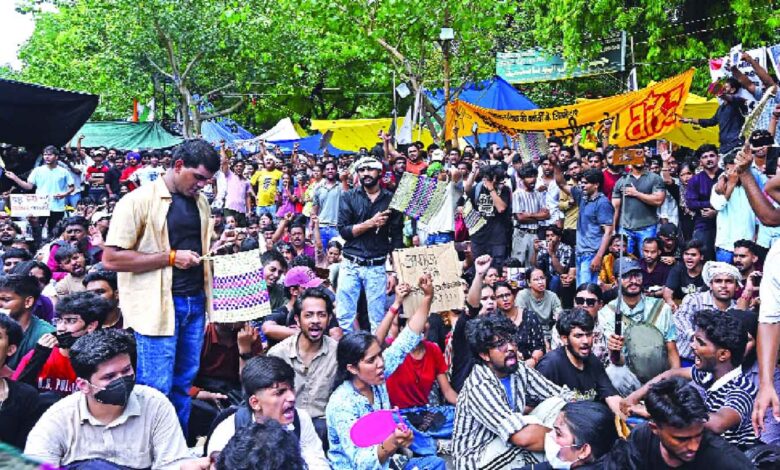
Throughout June and July, the country witnessed one of India’s largest digitally driven youth protests. In response to a controversial comment understood as comparing unemployed youth in India to ‘cockroaches’, the Cockroach Janta Party (CJP) was founded as an online political satire account. Within a few days, the account had garnered a significant following, and CJP’s presence quickly went viral, especially among young Indians who sought camaraderie amid their frustration over unemployment, examinations and recruitment irregularities across the nation. Sharpened by the aim of demanding accountability, the movement had, by June, crossed the important boundary between online discussion and offline protest and mobilisation. The CJP protest, better known as the Gen Z protest, has raised wider questions about how the government, institutions and political parties engage with the Gen Z that has made its political expression visible. However, sections of this generation are still learning how to translate this visibility into sustained political influence, especially in a country already brimming with seasoned political voices. Gen Z relies less on lengthy speeches for political communication; rather, they use sarcastic placards, translate resentment into memes, and display dissent through hashtags that can travel farther than the actual protest ever can. The growth of CJP from an online parody into a movement rallying the anger of India’s youth is a vivid demonstration of Gen Z’s political debut. A political debut does not necessarily require the formation of a political organisation, but rather to engage in day-to-day politics through whichever fields they choose to be in. Thus, allowing the ‘personal’ to inform the ‘political’.
What is important is that the state need not be apprehensive, nor the mainstream media be too eager to discipline or mellow the anger. Rather, the entire ecosystem needs to brace itself to engage with the younger electorate that consumes information rapidly, questions claims boldly and publicly, and demands accountability and solutions in real time. The youth must also be aware not to confuse digital fluency with political literacy.
The generation of political continuity
The ruling government came to power in May 2014 and is currently serving its third term. An individual who is 18 years of age in 2026 was approximately six years old when the present government’s tenure at the Centre began. This implies that many first-time and even second-time voters haven’t witnessed a Central leadership transition that would help them make decisions based on their lived comparative understanding. They have been watching the present government remain in power ever since they could start making sense of what it means to be an Indian citizen.
The youth is bound to compare the present government with the government’s own promises from the previous terms. Thus, the present establishment is competing not only against the Opposition but also against itself. This changes the narrative of performative expectations for the current government and thus increases its challenges in the coming elections. The generation before Gen Z might have asked for basic facilities like roads, connectivity and electricity. But Gen Z considers these basic necessities and assumes they should be provided without having to ask. And optimistically, there is nothing wrong in having higher expectations from the state. If anything, it is a living example of a progressive society, not just in terms of economy but also in the expansion of one’s thoughts and intellectual horizons. It also implies that the markers of development have progressively evolved among Indian youth, and so have their expectations of the state. The paradox of development is that its success itself produces higher expectations.
The constitutional bargain of liberty
Today’s generation has every right to demand a higher form of development and accountability from the decision-makers. However, if legitimate demands are indiscriminately portrayed as a threat to the constitutional sanctity of the country, then the very core of democracy weakens, or rather shrinks. Similarly, if younger citizens confuse political awakening with political education and maturity, their dissent may remain loud in expression but shallow in democratic purpose. Isaiah Berlin’s concepts of negative and positive liberty sit well with the current scheme of events. For Berlin, negative liberty concerns the absence of enforcement or restraint, leaving the individual free to pursue the actions of his choice. Positive liberty, on the other hand, relates to the individual’s capacity to achieve self-mastery, autonomy and the ability to exercise control over one’s life and actions. Democratic dissent involves both, with constantly varying degrees of complex inclusion. The absence of state restrictions in the sphere of expressive dissent is as important as the presence of political conscience among the protesters expressing that very dissent. The Indian Constitution presents this democratic bargain in a more precise manner. Article 19 of the Indian Constitution guarantees its citizens the freedom of speech and expression and the right to assemble peacefully without arms. It permits reasonable restrictions on the exercise of the right in the interests of the sovereignty and integrity of India or to uphold public order. The Constitution’s fundamental duties under Article 51A, among other things, ask the Indian citizens to develop a scientific temper and the spirit of inquiry and reform, while safeguarding public property and abjuring violence. The Indian Constitution does not present rights as conditional rewards upon political conformity or to those who perform their duties satisfactorily. It respectfully leaves the realization of the underlying responsibility in the hands of the people. This is exactly where political maturity is required to exist and function. The Constitutional recognition and protection of dissent does not place the actions outside the purview of law, public order and civic responsibilities.
Why does the grey matter?
We live in times of prime-time debates, which make it extremely difficult to acknowledge a grey reality. Someone who is even faintly aware of political functioning understands that there is no stark black-and-white. Understanding the Gen Z protest is thus more demanding and complex than the television debates portray them to be. The democratic stronghold of dissent becomes impoverished with the need to classify each protest as either heroic or irresponsible. A protest may raise important and relevant grievances, while some of its methods might still remain open to criticism. Similarly, a state may act within its legal capacity to maintain public order and still employ questionable methods of control. Social media may also be used to channelize a protest and gather participation, yet still be used as a tool for oversimplifying or misinforming events. Political inexperience may also give rise to opportunistic actors seeking to redirect the movement onto a different trajectory.
Uttarakhand and the aspirational Gen Z
The current agitation is of significant importance to the youth and future voters of Uttarakhand. The issues the agitation represented are very similar to those the youth of Uttarakhand have been struggling with over the past few years. Uttarakhand stands at the intersection of a high literacy rate and a high gross enrolment ratio, yet significant unemployment and employment-related migration persist. The NITI Aayog report on the School Education System in India places Uttarakhand’s higher secondary Gross Enrolment Ratio (GER) at 80.9%, which is higher than the national average of 58.4%. The state has performed better than its counterparts in other parameters, where the numbers suggest improved GER across different educational levels and reduced dropout rates. Similarly, the All India Survey on Higher Education (AISHE) 2023-24 by the Ministry of Education of places Uttarakhand as one of the top performers with GER in higher education for 18-23 age group at 48.5%, which is higher than the all-India GER of approximately 30%. Uttarakhand also features among the top 10 states with the highest college density which implies the number of colleges per lakh eligible population (aged 18-23). Despite impressive school retention rates and higher education participation numbers, the state’s unemployment rate, for those aged 15-29, as estimated by the Periodic Labour Force Participation Survey 2025 is 13.9%. By region, the numbers are 11.4% for rural youth and 18.4% for urban youth, both higher than the national average for each category. The estimated urban female youth unemployment rate is even higher at 26% as compared to 18.9% nationally.
Reading Uttarakhand’s education and employment numbers together reveals a peculiar combination that highlights a gap between educational attainment and employment opportunities. An educated generation is less likely to be persuaded by mere promises or rhetoric. Uttarakhand currently possesses a large demographic cohort of the youth population, whose educational, professional and political aspirations will shape the state’s political future.
The 2024 Lok Sabha elections saw notable voter support for independent candidates who raised issues of youth unemployment, examination irregularities, and recruitment malpractices. With the state going to the polls next year for the state assembly, it is important that the youth drive an informed political conversation.
Dissent: After the crowds disperse
This is a golden opportunity for the younger generation to establish its political footing. Any consolidated effort by individuals that demands long-standing change from those in power requires translating their lived experiences into political choices and opinions. Only then can an informed voter and citizen be born. In doing so, it is also worth noting that democratic engagement requires more than episodic involvement with viral content. Meanwhile, the state must remain open and confident to accommodate and face criticism, peaceful dissent and even satire without treating disagreement as disloyalty.
(Semwal is head of Political Science at HNB Garhwal Central University, Naithani is a senior research scholar; views expressed are personal)