
PIONEER EDGE NEWS SERVICE/ Roorkee
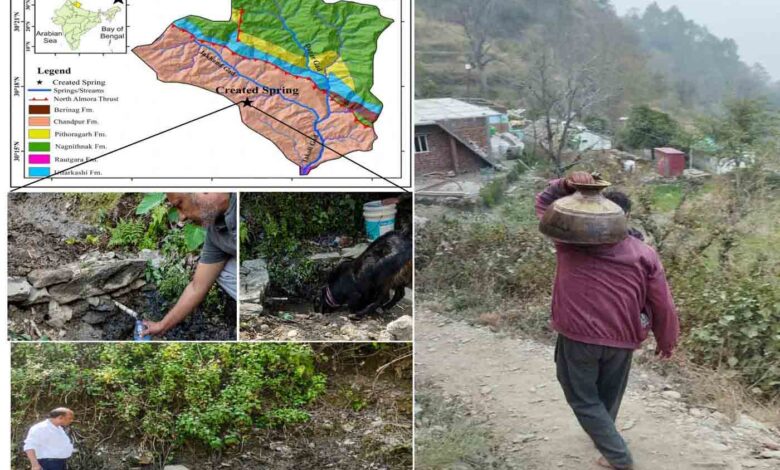
In an effort to address seasonal water scarcity in the Himalayas, the Indian Institute of Technology Roorkee (IIT Roorkee) has developed a new spring in Unchaun village, Tehri district. The intervention has reportedly increased lean-season drinking-water availability from approximately 500 litres to 1,000 litres or more per day, demonstrating how scientific understanding of Himalayan spring systems can inform practical solutions for rural water security, IIT Roorkee said.
The initiative is part of the project ‘Rejuvenation of Drying Springs in Takoli Gad Catchment of Tehri District, Uttarakhand,’ funded by Namami Gange, National Mission for Clean Ganga, Union Ministry of Jal Shakti. Notably, IIT Roorkee is the lead institute with Prof Abhayanand Singh Maurya, department of Earth Sciences, serving as the principal investigator.
The intervention draws on findings from two research studies conducted in the Takoli Gad watershed in the Lesser Himalaya, covering approximately 143 square kilometres within the Alaknanda River basin.
The first study, ‘Decoding the hydro-meteorological processes of spring recharge dynamics in the Alakananda River basin through stable and radioisotopes,’ was published online in the Hydrological Sciences Journal while the second study, ‘Lithological controls on seasonal weathering processes in a non-glaciated Lesser Himalayan spring system,’ was published in Applied Geochemistry. “Together, the studies provide complementary insights into the processes that replenish springs and influence their water quality, offering a scientific basis for site-specific spring-shed management and groundwater conservation,” Maurya said.
The director, IIT Roorkee, Prof K K Pant said, “Scientific research creates the greatest public value when it helps address challenges faced by communities. At IIT Roorkee, our efforts to understand Himalayan spring systems reflect the importance of connecting research with local needs and sustainable resource management.”