IIT Roorkee research highlights emerging climate signals in Himalayan weather systems

PIONEER EDGE NEWS SERVICE/Dehradun
A new research study from the Indian Institute of Technology (IIT) Roorkee has revealed a fundamental shift in the behaviour of western disturbances, a critical weather system governing rainfall and snowfall across the Himalayan region, raising fresh concerns over climate resilience, disaster preparedness and water security in northern India.
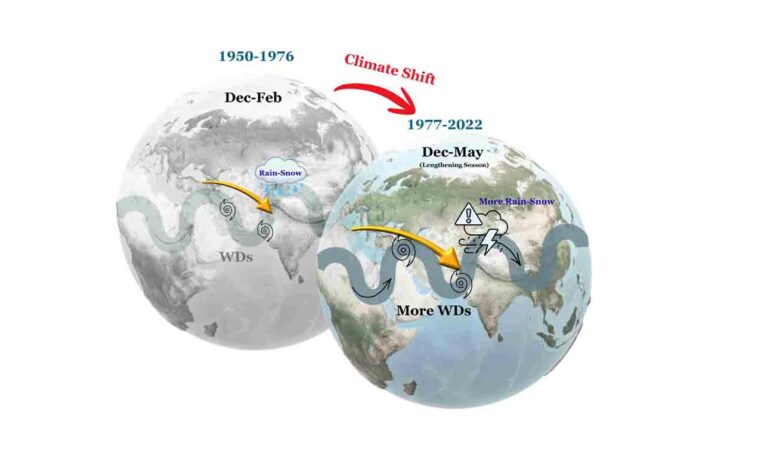
Traditionally associated with winter snowfall, western disturbances are now showing increasing influence during the pre-monsoon months, altering the seasonal balance of precipitation across the Himalayas and adjoining regions. The findings, published in the International Journal of Climatology, suggest that climate warming is not only intensifying extreme weather events but also reshaping the timing, structure and impact of large-scale atmospheric systems. The IIT Roorkee study shows that western disturbances are becoming more active beyond the cold season, travelling longer distances and potentially accumulating higher moisture before reaching the Indian subcontinent. As a result, precipitation linked to these systems is increasing particularly during the March to May period. This shift significantly increases the risk of flash floods, landslides, and extreme rainfall events across the fragile Himalayan terrain, while also altering long-term water availability in downstream regions.
By analysing over seven decades of atmospheric and rainfall data, the researchers identified marked behavioural and structural changes in western disturbances pathways, including longer travel distances, enhanced moisture uptake and stronger upper-level winds. These factors together amplify rainfall intensity outside the traditional winter window.
The study underscores the urgent need to revisit climate models, forecasting frameworks, and disaster management strategies, particularly for Himalayan states that are witnessing a rising frequency of weather-related disasters.
PhD scholar in the institute’s department of Hydrology, Spandita Mitra said, “As a researcher working closely with long-term climate data, it is striking to see how consistently western disturbances are changing their seasonal role. What we are observing on the ground today, erratic rainfall and sudden extreme events, clearly reflects these larger atmospheric shifts. Extreme events, such as the 2023 Himachal flood and the recent 2025 Uttarakhand flood, also reflect the growing influence of these disturbances, even during the monsoon season,” Mitra said.
“Our analysis shows that western disturbances are undergoing significant seasonal and structural changes, particularly during the pre-monsoon period. This transition has far-reaching implications for water resources, extreme weather events, and disaster vulnerability in the Himalaya and adjoining regions.” said Ankit Agarwal, lead principal investigator, Department of Hydrology, IIT Roorkee.
The institute director KK Pant said, “Scientific evidence such as this is crucial for rethinking how we plan for climate resilience in ecologically sensitive regions like the Himalaya. This study reinforces IIT Roorkee’s commitment to advancing climate science that directly informs policy and preparedness. As climate change accelerates, institutions must play a proactive role in translating scientific insights into actionable strategies for sustainable development and disaster resilience,” he said.
Researchers said that with western disturbances continuing to evolve under a warming climate, the study calls for dynamic forecasting frameworks and region-specific risk assessments to safeguard lives, livelihoods and critical ecosystems.