

Prem Prakash Upadhyay/ Pithoragarh
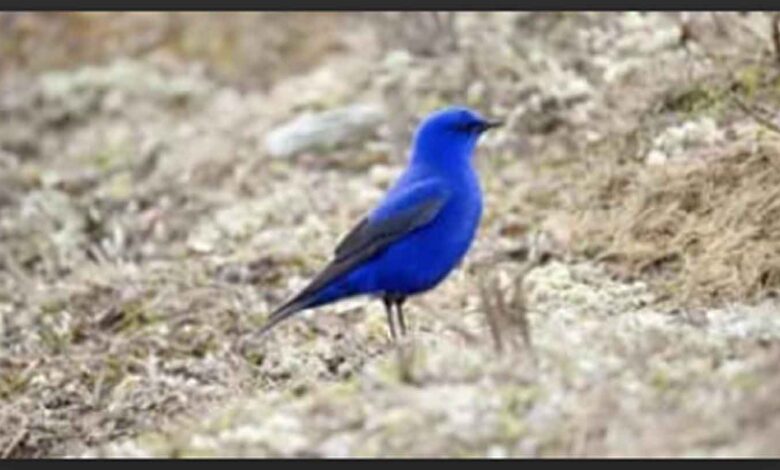
A large flock of the rare Himalayan bird called Grandala has been sighted in the high-altitude Johar Valley of Munsiyari near India–China border, drawing the attention of wildlife watchers and researchers.
Notably, the organisation focused on conserving Himalayan biodiversity, MONAL (Mass of Nature and Adventure Lovers) has been studying the species’ behaviour and seasonal movement over the past two months. Sharing details of the sighting, the president, MONAL, Surendra Pawar said that the presence of a flock of 150 to 200 Grandalas had been recorded for the first time in the Martoli village area. “Following this remarkable sighting, researchers have intensified field observations to monitor the birds,” he added.
The ornithologists describe Grandala as one of the Himalayas’ most amazing bird species. The male displays a deep cobalt-blue plumage, while the female is brown in colour. The species is highly social, often living and flying in flocks that may number in the hundreds, they further say.
The ongoing study has found that Grandalas inhabit alpine meadows, rocky slopes and other high-altitude landscapes. Their diet mainly consists of insects, small fruits and wild berries. The birds also shift their elevation seasonally in response to changing weather conditions.
Sharing more, Pawar said that the study aims not only to document the birds but also to assess the ecological significance of the Johar Valley for the species. “If Grandalas continue to appear here in large numbers every year, the valley could emerge as a key habitat for Himalayan bird conservation,” he noted.
The organisation has appealed to villagers, trekkers and tourists not to feed the birds, avoid approaching them closely and observe them only from a distance.
“Once the study is completed, the findings will be submitted to the Forest department and scientific institutions to help formulate effective conservation strategies for this avian species,” Pawar added.