

PIONEER EDGE NEWS SERVICE
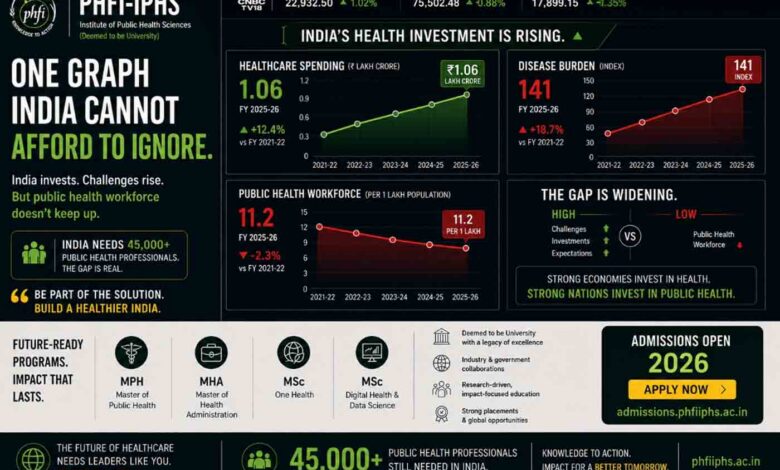
As India significantly expands investments in healthcare through initiatives such as Ayushman Bharat, the Digital Health Mission, AI-enabled healthcare and disease surveillance, experts have highlighted a critical challenge that could limit the impact of these reforms—the shortage of trained public health professionals.
According to the PHFI Institute of Public Health Sciences (PHFI-IPHS), the country currently requires more than 45,000 additional public health professionals to meet the growing demands of its healthcare system. While spending on healthcare infrastructure and services has increased substantially, the supply of professionals equipped to plan, manage and strengthen public health systems has not kept pace.
Formerly known as the Indian Institute of Public Health (IIPH), PHFI-IPHS was recently recognised as a Deemed-to-be University under the Ministry of Education’s Distinct Category of the UGC Regulations. The institution builds on nearly two decades of work by the Public Health Foundation of India (PHFI) in advancing public health education, research and policy.
A representative of PHFI-IPHS said that India’s healthcare ambitions require more than hospitals and medical infrastructure. “The country also needs skilled public health professionals who can strengthen health systems, develop evidence-based policies and improve healthcare delivery,” the representative said.
The COVID-19 pandemic underscored the importance of public health experts capable of monitoring disease outbreaks, analysing health data, designing health programmes and strengthening healthcare systems before crises emerge. Today, countries across the world are investing in epidemiologists, health economists, public health managers, digital health specialists and policy researchers to improve population health outcomes.
India faces emerging challenges such as changing disease patterns, climate-related health risks, rapid urbanisation, ageing populations, antimicrobial resistance and the digital transformation of healthcare. Experts believe these issues demand professionals with expertise in disease surveillance, health economics, healthcare management, environmental health, public policy, community engagement and implementation research.
PHFI-IPHS maintains that without a strong public health workforce, even the best healthcare infrastructure cannot achieve its intended impact.
To bridge this gap, the university offers multidisciplinary programmes including the Master of Public Health (MPH), Master of Health Administration (MHA), MSc in One Health and MSc in Digital Health & Data Science. The courses integrate epidemiology, health policy, behavioural sciences, management, data science and implementation research, preparing graduates for leadership roles in government agencies, healthcare institutions, research organisations, international bodies and industry.
The university also emphasises practical learning through exposure to national health programmes, government health systems, community initiatives, research projects, digital health technologies and global collaborations.
With campuses in Hyderabad, Bengaluru and Bhubaneswar, PHFI-IPHS aims to strengthen India’s public health capacity and prepare professionals capable of addressing both current and future healthcare challenges. The institution believes that developing a skilled public health workforce will be essential to ensuring that India’s growing healthcare investments translate into better health outcomes for millions across the country.