
GUEST COLUMN
 Kripa Nautiyal
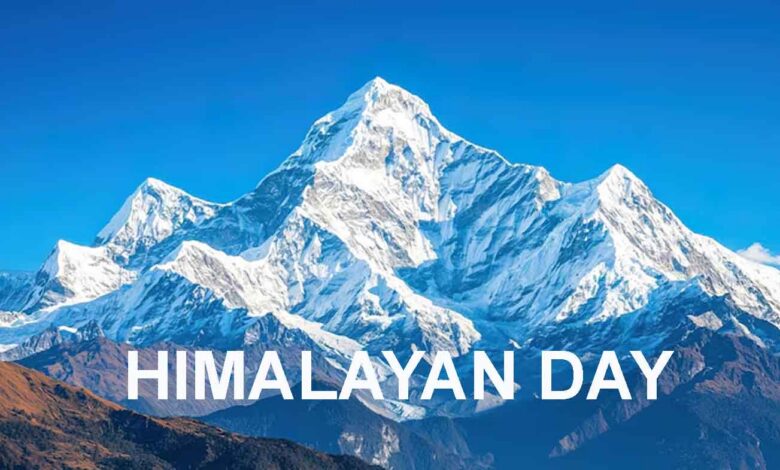
Every year on Himalayan Day, we pause to celebrate a mountain system that has shaped civilisations, sustained economies, and defined the northern edge of the Indian subcontinent for millennia. Yet this year, celebration alone feels insufficient. Behind the postcard images of snow-capped peaks and terraced valleys lies a quieter, more urgent story — one of emptying villages, sinking towns, warming glaciers, overwhelmed hill stations, and a national security question that has crept up on us largely unnoticed.
The Himalayas are part of a vast highland arc running nearly four thousand kilometres from Kyrgyzstan to Myanmar, encompassing the Pamir, Hindukush, and Karakoram ranges. Every one of the roughly four hundred mountains on earth that exceed seven thousand metres including all fourteen that top eight thousand lies within this system. Far from being an uninhabited wilderness, the Himalayas support around fifty million people, spanning an extraordinary range of ethnicities, languages, and faiths, with Hinduism, Buddhism, and Islam all converging across its length.
In India, the Himalayas cover Jammu and Kashmir, Himachal Pradesh, Uttarakhand, and the northeastern states, extending into Tibet, Bhutan, and Nepal. In Uttarakhand, communities like the Jaunsari trace their lineage to the ancient kingdom of Kuninda, remembered even in the Mahabharata — a reminder that these mountains have never simply been geography. They have been home, sanctuary, and civilisation, sustained by generations of traditional knowledge in farming, ethno-medicine, and reading the land itself.
That inheritance is now under strain from several directions at once.
There is now a warming of crumbling mountain.Nowhere was this made clearer than on 26 August 2026, when a section of glacier atop Langtang Lirung in Nepal collapsed without warning, sending a catastrophic surge of ice, rock, and water nearly a hundred kilometres down the Trishuli River. More than 390 people were killed and 1,500 reported missing after the glacial collapse triggered catastrophic flooding across the Nepal-Tibet border region, with entire settlements in Nepal’s Rasuwa and Nuwakot districts buried or swept away, and the strategic Gyirong border crossing with China destroyed. Satellite analysis showed the glacier moving at an accelerating rate in the months before it finally gave way — a pattern scientists link directly to warming temperatures and thawing permafrost in the high Himalaya. As one commentator observed in the disaster’s aftermath, the tragedy stands as a warning that melting glaciers and high seismic activity make the Himalayas a genuinely high-risk zone for the entire world.
This was not an isolated freak event. Uttarakhand’s own history includes the 2013 Kedarnath disaster and repeated glacial lake outburst warnings across Chamoli, Pithoragarh, and Uttarkashi. As glaciers retreat and permafrost weakens, the mountains that sustain a fifth of humanity are becoming measurably less stable — and the communities living closest to them are the first to pay the price.
Joshimath’s case is a a warning from within.
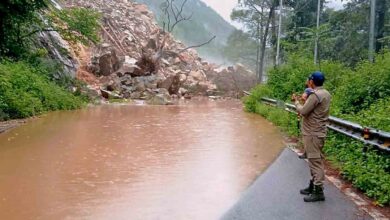
Instability is not confined to remote glaciers. In early 2023, the town of Joshimath — gateway to Badrinath and home to around 20,000 people — began visibly sinking, with cracks spreading through homes, hotels, and roads until construction had to be banned across the area. Experts at the time stressed that resettlement must balance risk, impoverishment, and reconstruction carefully, with fair compensation so displaced families are not left destitute. Joshimath was a warning that unplanned construction and disregard for fragile mountain geology can turn any Himalayan town into a slow-motion disaster — a lesson Dehradun itself risks repeating, where geologists have raised alarm over multi storey towers rising in a major seismic zone, often approved on inadequately verified soil-testing reports.
The Himalyas are also getting affected by weight of too many feet visiting it . Char Dham pilgrimage numbers and hill-station visits have surged into the millions annually, straining water supplies, waste systems, and roads never designed for such volume. Even international pilgrimage routes are exposed: the Gyirong crossing destroyed in the 2026 floods carried over 100,000 crossings in just the first half of the year, much of it tied to the Kailash pilgrimage. Unregulated construction for resorts and homestays, hillside deforestation, and vehicles idling for hours on narrow roads add further pressure to a landscape already destabilised by climate change — turning affection for these mountains into one more force degrading them.
There is a crisis behind the celebration as
Over the past two decades, Uttarakhand has lost lakhs of people from its remote hill districts to outmigration. State records now classify more than 1,800 villages as “ghost villages” completely abandoned — with another 1,000 having lost more than half their population. Villages once celebrated for their crafts, such as one in Pithoragarh once renowned for wood carving, now stand hollowed out, as have similar villages across the Nepal border. The causes are painfully mundane: no roads, no schools within reasonable distance, no healthcare, and no reliable livelihood conditions residents describe as daily treks through wild, leopard-inhabited terrain simply to reach a school.
What makes this crisis different from ordinary rural-to-urban migration elsewhere in India is geography. These are not interior villages — they sit along India’s most sensitive and contested frontiers with China and Nepal. That is where a demographic and developmental issue becomes a national security one.
Empty borders indeed are dangerous borders
Inhabited border villages perform functions no technology can fully replace. Locals have traditionally served as the eyes and ears of security forces, offering ground-level intelligence, informal early warning, and logistical support that satellites cannot replicate — a role documented as far back as the 1962 war and the 1999 Kargil conflict. As villages empty, this human network collapses, forcing security forces to stretch thin resources across larger, uninhabited zones, while depopulated areas also weaken India’s claims of effective territorial control, a principle central to resolving border disputes.
The contrast with China is stark. Beijing has invested heavily in Tibet’s border regions — new settlements, roads, military infrastructure, and deliberate population-settlement programmes — while comparable Indian forces are often based near sea level and require lengthy acclimatisation before deployment. Where China is repopulating its side of the Line of Actual Control as strategy, India’s border districts are demographically retreating.
Outmigration further erodes the recruitment base for regiments like the Garhwal and Kumaon Rifles, prized for natural acclimatisation to altitude, while removing the community vigilance that has long helped monitor smuggling and trafficking along the open Nepal border, and the local knowledge and manpower that disaster response depends on most when a crisis strikes.
Reasons for Hope
None of this is irreversible. India’s own experience during COVID-19 showed that reverse migration is possible when circumstances demand it, and mountain regions in Switzerland, Japan, Austria, South Korea, and Norway have all confronted similar decline and found ways to stabilise or reverse it — models Uttarakhand can adapt.
Addressing this requires treating border regions as both a developmental and a security priority, together. Practical steps include: creating “strategic border development clusters” with concentrated investment in roads, connectivity, healthcare, and schools; strengthening delivery of the Border Area Development Programme and Vibrant Villages Programme, which currently suffer gaps between allocated and released funds; adapting Japan’s “Furusato” hometown-tax model, advocated by me in number of forums, so migrants can direct part of their income tax to their ancestral villages; and mobilising retired soldiers as formal village defence volunteers. Equally urgent is building climate and disaster resilience directly into this agenda — glacial lake monitoring, stricter enforcement of seismic building codes, and an independent technical review of construction in towns like Joshimath and Dehradun — alongside regulating tourism growth through visitor caps, waste management mandates, and genuine enforcement of environmental clearances on the Char Dham and other pilgrim routes, so that the mountains are not loved to death even as they are repopulated.
Himalayan Day should be more than a commemoration of natural beauty. It is a reminder that these mountains are inhabited, living, and fragile strategic spaces , where every abandoned village is a quiet retreat of India’s presence at its most sensitive frontier, every unregulated tower and overcrowded pilgrim route is a disaster waiting to happen, and every warming glacier is a warning we can no longer treat as distant.
In this Himalayan state, demography and geology are both destiny. Recognising that truth through sustained investment, disciplined regulation, and genuine partnership between defence, development, science, and local communities is no longer optional. It is a national security and survival imperative that can no longer be ignored.
(The author is an Anthropologist and defence and strategic study expert. He has udertaken research on an unique Himalayan Tribe )