
GUEST COLUMN
 Kripa Nautiyal
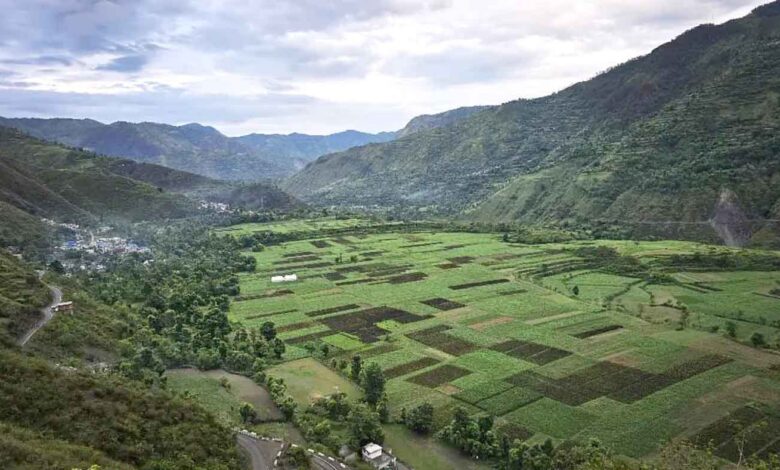
The roaring Tons river does not merely cut through the emerald gorges dividing Uttarakhand and Himachal Pradesh; it carries the unbroken pulse of generations. Stone-and-timber homes stand against mountain winds. Orchards carved from rugged slopes by generations of hands still yield fruit. Courtyards across Sirmaur, Shimla and Dehradun echo with folk songs beneath Himalayan skies. Every whispering pine, every cold spring, every shrine of the local deotas is woven into the cultural memory of this land. It is not merely revenue plots measured in hectares. It is living history. It is identity. It is home.
Today, a silent shadow hangs over these valleys. The renewed push for the colossal Kishau dam threatens to submerge much of this centuries-old landscape beneath tens of metres of water. To planners in distant offices, the Tons basin is a catchment area, a reservoir contour on a blueprint for electricity and water supply. But to the mountain mother beside the river, or the elderly patriarch looking at the courtyard his grandfather built, it represents the possible end of an entire way of life. To uproot a hill family from its ancestral soil is not to relocate a household. It is to uproot a deeply rooted tree and expect it to bloom in unfamiliar ground.
A mountain village is an interconnected social organism — fields cultivated together, forests providing collective sustenance, festivals binding generations. It is held together by relationships no land record can capture. When a valley is submerged, what disappears is not merely land. It is ancestral graves, sacred sites, forests, springs, temples, schools — the physical spaces where collective memory was made. One can almost imagine the elderly sitting beside the rushing Tons, eyes moist, hands trembling, asking a question no compensation package can answer: Must our memories, our deities and our roots be consigned to a watery grave so that distant cities may prosper?
This anguish is not an abstraction to me. A dear friend of mine from Kwanu — one of the most breathtakingly beautiful villages of Jaunsar-Bawar, now likely to pass into history with this dam — could barely hold back his tears when we spoke of it. How, he asked, could a people so deeply attached to their roots, their culture and their hills ever find comfort on the plains, or anywhere else? And then, through his tears, he said something I have not been able to forget: that our revered deity, Chalda Mahasu Maharaj, would simply not let this happen. For him, as for countless others across these valleys, the dam is not a question of engineering or rehabilitation policy. It is a matter of faith — a conviction that the deities who have always watched over this land will not stand by as it is taken.
The case for involuntary displacement has always rested on the “greater good of the greater number”. But history teaches that the burden of such development is rarely shared equally. Benefits travel far beyond the affected region; costs fall heaviest on those who surrender their homes and social worlds. There must first be a genuine pause — an honest reckoning with whether such an irreversible intervention in these fragile, living mountains can be justified, and at what human cost. If the project is ultimately unavoidable, the State must not treat the affected as numbers in a ledger. Rehabilitation must be conceived not as compensation, but as the reconstruction of a life. These risks were first mapped systematically by development anthropologist Michael Cernea, whose Impoverishment Risks and Reconstruction (IRR) model remains the most widely followed international framework for planning against the harms of forced displacement. Adapted by the World Bank, the Asian Development Bank and national rehabilitation policies worldwide, its insight is demanding: resettlement is not complete simply because a family has been moved and paid. It is complete only when landlessness is reversed through land-based resettlement, joblessness through sustainable re-employment, homelessness through proper rebuilding, and community disarticulation through the deliberate reconstruction of village life at the new site. This — not the older yardstick of one-time cash compensation — is the standard against which any Kishau rehabilitation plan must be measured. A farmer who loses his orchard loses years of labour and generations of accumulated knowledge. A woman who loses the village forest may travel far greater distances for fodder and fuel. A child separated from grandparents and familiar institutions may lose an irreplaceable part of his cultural inheritance. Every such vulnerability demands a deliberate strategy of reversal: land of comparable productive potential, sustainable livelihoods rather than one-time payments, homes rebuilt to mountain architectural and climatic needs, and food security, healthcare and education guaranteed from day one.
For people who have lived on ancestral soil for generations, displacement is a form of prolonged bereavement. They are not merely leaving a house, but the landscape where their children took first steps, where marriages were solemnised and the dead committed to the earth. No cheque can compensate for that. Equally critical is the protection of Common Property Resources — community pastures, civil-soyam forests, natural drinking-water sources, cremation grounds, village paths. These are the invisible infrastructure of the mountain economy. When they vanish beneath a reservoir without equivalent replacement, livestock-based livelihoods collapse and community life fragments. Geography, too, cannot be overlooked. The anguish of communities displaced elsewhere in the Himalayas — “We are people of the snow; how will we live in the plains?” — should warn every planner. Relocating hill communities to the plains is not a change of address; it is a different climate, agriculture, and way of life altogether. Where relocation is unavoidable, priority must go to comparable hill environments — and resettlement sites must be fully ready, with land, homes, roads, water, electricity, schools and healthcare in place, before a single family is asked to leave.
Above all, the people themselves must have a voice. The era of top-down paternalism must give way to participatory rehabilitation, with village elders, women and youth formally represented in every decision — from site selection to the preservation of sacred spaces. They are the ones who understand best what makes a home a community. The Kishau dam will be presented in the language of megawatts and national development. These are legitimate goals. But another vocabulary must also find a place in the project documents: memory, dignity, belonging, culture and human loss.
The Tons is not merely a river. For those who have lived along it for generations, it is part of their collective biography. Progress must never be purchased with the silent tears of those who give up everything so that others may prosper. If the State must take their land, it owes these hill families far more than compensation and ledger clearances. It owes them justice. It owes them dignity. And above all, it owes them a solemn commitment that when they leave their ancestral homes, their cultural soul will not be left behind.
(A retired additional director general of Indian Coast Guard and an anthropologist, the author has undertaken extensive research in the Jaunsar-Bawar region; views expressed are personal)