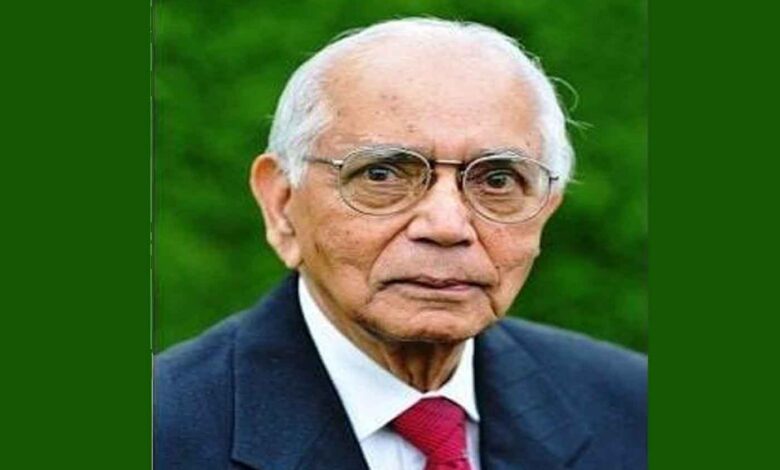
Remembering Prof C R Rao on his 106th birth anniversary: A Statistical Legend of Global Eminence

By Dr M Vishnu Vardhana Rao, vice chancellor, PHFI IPHS Deemed to be University & ICMR Chair for Medical Statistics
A boy was born into a Telugu-speaking family in Hadagali, in Karnataka’s Bellary district, on September 10, 1920. Who could have imagined that this boy, Calyampudi Radhakrishna Rao (C R Rao), would go on to become the “Wizard of Numbers” and eventually transform the world of statistics? His journey from a small town in Karnataka to the highest levels of global science is a remarkable story of intellectual brilliance, perseverance and an enduring commitment to knowledge.
Rao’s academic journey began in Andhra Pradesh, where he studied at Gudur, Nuzvidu and Nandigama. For his higher education, he joined Andhra University, Visakhapatnam, where he graduated in Mathematics and completed his MA in Mathematics in 1940 with First Class and First Rank. His association with Andhra University has endured even after his lifetime. The road adjacent to the Department of Statistics on the university campus has been named ‘C R Rao Marg’, commemorating one of the university’s most illustrious alumni.
After completing his postgraduate studies at Andhra University, the young Rao arrived at the Indian Statistical Institute (ISI), Kolkata, in the early 1940s, initially in search of a career. What appeared to be a chance turn in his life would eventually change the course of statistical science. His exceptional mathematical ability and academic brilliance soon attracted the attention of Prof P C Mahalanobis, the founder of ISI and one of the architects of modern statistics in India.
A major turning point came when Rao was invited to work on an anthropological project involving skeletal remains from Jebel Moya in Sudan, under the University of Oxford’s Department of Anthropology. His work on the project contributed to the landmark publication Ancient Inhabitants of Jebel Moya. At the same time, he pursued doctoral research at the University of Cambridge, completing his PhD in 1948.
It was at Cambridge that Rao came into contact with Sir Ronald A Fisher, one of the founding figures of modern statistics. The intellectual environment at Cambridge, combined with his earlier training at ISI, laid the foundation for a career that would profoundly influence statistical theory and practice.
Rao returned to India in 1948 and resumed his work at ISI. He became professor and head of the Research and Training School. He became director of the Research and Training School in 1963 and, following the death of P C Mahalanobis in 1972, became director and secretary of the Indian Statistical Institute, serving from 1972 to 1976.
In 1979, another important chapter began when Rao was invited to the University of Pittsburgh to deliver a lecture. The visit led to an academic appointment, and he subsequently played an important role in developing statistical education and research there. He later joined Pennsylvania State University, where he continued his research and mentoring for many years, formally retiring in 2001 at the age of 81.
His academic achievements during this remarkable career were extraordinary. In addition to his PhD and Sc D from Cambridge University, he received 27 honorary doctoral degrees from universities in 16 countries. He published around 500 scientific papers, authored or co-authored numerous influential books, and supervised and guided nearly 40 doctoral students.
But numbers alone cannot capture the magnitude of Rao’s contribution.
Prof C R Rao’s name is inseparably associated with some of the most fundamental results in modern statistics. The Cramér–Rao inequality, for example, provides a fundamental lower bound on the variance of unbiased estimators. In simple terms, it tells statisticians how accurately an unknown quantity can be estimated from data. It has become a cornerstone of statistical estimation and has applications extending far beyond traditional statistics.
The Rao–Blackwell theorem provides a powerful way of improving statistical estimators, enabling researchers to obtain more efficient estimates from available information. Combined, these results help scientists more efficiently extract information from data. His contributions did not stop there. Rao made fundamental contributions to multivariate analysis, experimental design, statistical inference, information theory and geometry, influencing disciplines ranging from economics and engineering to genetics, medicine and the social sciences.
One of the most fascinating aspects of Rao’s legacy is the continuing relevance of his early work to the modern world of artificial intelligence and data science. His doctoral work at Cambridge involved discriminant analysis, a statistical method for distinguishing between groups using multiple characteristics. What was once regarded as an important statistical technique has strong conceptual links with what we now call supervised learning in machine learning.
Today, when enormous volumes of data are generated every second, the ability to identify patterns, distinguish groups, estimate uncertainty and extract meaningful information from complex datasets is at the heart of artificial intelligence. Many of the principles underlying these modern technologies have deep roots in the statistical ideas developed by pioneers such as C R Rao.
Rao also left an important institutional legacy in Hyderabad through the C R Rao Advanced Institute of Mathematics, Statistics and Computer Science (AIMSCS) on the University of Hyderabad campus. A fitting tribute to the departed legend would be to ensure that this Institute continues to nurture world-class statisticians, mathematicians, computer scientists and data scientists, strengthening India’s capabilities in statistics, artificial intelligence and big-data analytics.
Rao’s monumental contributions earned him some of the world’s highest scientific honours. In India, he was awarded the Padma Vibhushan, one of the country’s highest civilian honours. In 2002, he received the National Medal of Science, the highest scientific honour bestowed by the President of the United States.
Then, at the remarkable age of 102, Rao once again made international headlines. In 2023, he was awarded the International Prize in Statistics, one of the world’s most prestigious honours in statistics and often described as the field’s equivalent of the Nobel Prize.
The recognition was not simply for a lifetime of publications. It was an acknowledgement of the profound influence his ideas have had on science, technology and human understanding.
There is a poignant coincidence in India’s scientific history. On August 23, 2023, the day India scripted history by becoming the first nation to successfully land near the Moon’s south polar region, it bid farewell to one of its brightest mathematical stars.
Calyampudi Radhakrishna Rao, one of India’s greatest mathematicians and statisticians, passed away in the United States in the early hours of August 23, 2023, just over two weeks before his 103rd birthday.
From a small town in Karnataka to the highest echelons of global science, C R Rao’s journey is a story of intellectual brilliance, perseverance and vision. His life demonstrates how mathematical thought, when combined with curiosity and discipline, can transcend geographical boundaries and influence generations of scientists across the world.
The “Wizard of Numbers” may have left this world, but the numbers—and the ideas he gave them—continue to speak, inspire, and guide generations of young minds.