
PIONEEREDGE NEWS SERVICE/Dehradun
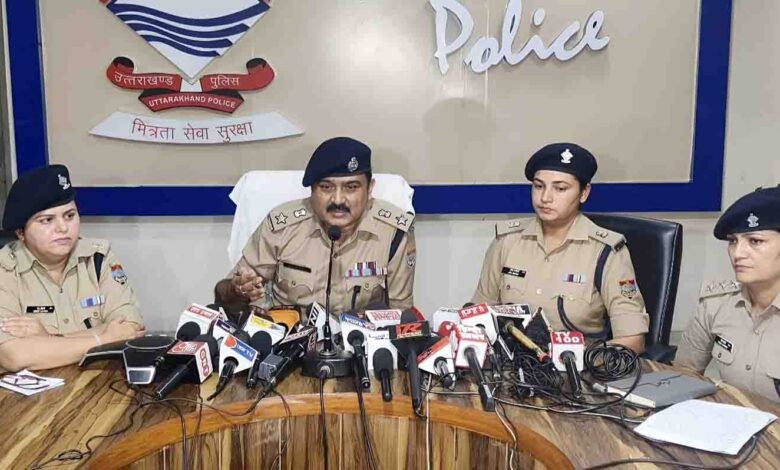
Dehradun police denied the claims made in the National Annual Report and Index on Women’s Safety (NARI) 2025 launched by the National Commission for Women (NCW) last week that placed Dehradun among 10 most unsafe cities in the country out of 31 included in the survey. In a Press conference on Tuesday, Dehradun senior superintendent of police Ajai Singh said that placing the city in the list of unsafe cities on the basis of an independent private survey is not justified. He added that the report does not clarify who participated in the survey, their age, education or employment status.
The SSP stated that the survey was conducted by a private data science company named P Value Analytics and not by the national or state women’s commissions or any statutory body. He said that the survey relied on computer-assisted telephone and personal interviews with 12,770 women across 31 cities, with only 400 participants from Dehradun out of a population of around nine lakh women. Singh said that conclusions based on such a small electronic sample cannot represent the city.
The SSP stated that police records show that in August, Dehradun received 12,354 complaints through Dial 112, of which 2,287 were related to women. Among these, 1,664 were linked to domestic disputes and only 11 complaints involved harassment or assault, which is less than one percent of total women-related complaints. The average police response time was 13.33 minutes. According to the SSP, “Dehradun scored 33 per cent in police patrolling in the survey, while Kohima, listed as the safest city, scored 11 per cent. On harassment in public places, Dehradun scored six per cent compared to the national average of seven per cent. This shows that women in Dehradun reported feeling safer in public spaces than in other cities.”
He further said that Dehradun has 70,000 students from outside the State, including foreign nationals, with 43 per cent being women. He pointed out that the presence of central institutions, universities and tourist footfalls reflect confidence in the city’s safety environment. Singh claimed that women can access safety tools such as the Gaura Shakti app with 1.25 lakh registrations, including 16,649 in Dehradun alone, as well as Dial 112, the State police app and citizen portals. The city has also set up help desks at every police station, pink booths in crowded areas, women patrolling teams named Gaura Cheetah and integrated CCTV systems with around 14,000 active cameras mapped with Google. He also claimed that National Crime Records Bureau (NCRB) data shows that Dehradun has a lower crime rate than metro cities.
Singh stated that while surveys should be respected, policy decisions require strong methodology with clarity on sampling, question framing and the definition of safety. Surveys guiding policy decisions should only rely on scientific and factual methods, he added.