
HILLBILLY
 Lokesh Ohri
Mussoorie as a destination has been popular since the last two centuries. Rewarded with sobriquets such as “Queen of Hills” and “Edinburgh of the East”, Mussoorie has been attracting visitors from across the world. Tourism, therefore, has been the mainstay of not only the hill station’s economy, but also of the many small towns and stations around it.
Today, the kind of tourism which the hill station attracts has changed. With a transformation in the speed and means of travel, the form of tourism Mussoorie attracts is more weekend tourism or shorter duration tourism, as against the tourism for the entire season in the past. The quantity and quality of tourism to Mussoorie is expected to further undergo tremendous change with the coming up of new expressway which is claiming to reduce travel time from New Delhi to Dehradun to about 2.5 hours. This will usher in an era of day visitors too, looking for an experience that gives them a true feel of the hill station.
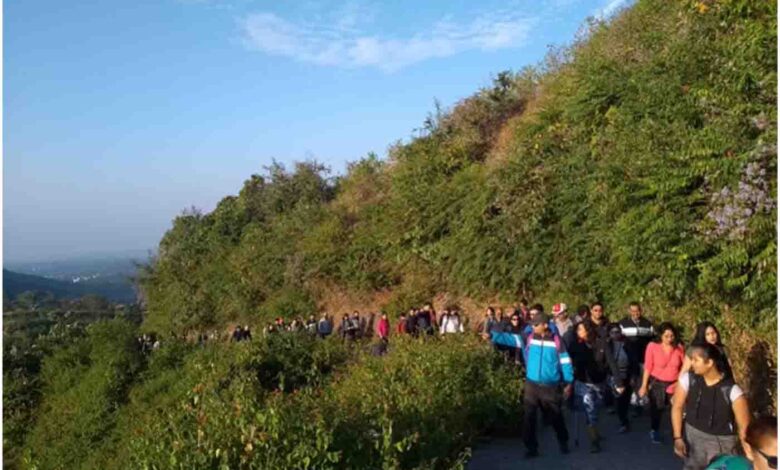
In the vastly improved accessibility, the challenge for Mussoorie is to remain an attractive destination that can protect its green cover and unique ecology, without which it shall not be able to attract any visitors. The Jharipani-Kipling trail could, therefore, emerge as a gamechanger experience that strikes this unique balance that offers a glimpse of both history and nature, while also not burdening the already impacted environment of the hill station. This is a unique walking trail that exudes both history and adventure. We begin walking at the Shahenshahi Ashram. This is a lovely path for bird watching and has spectacular views of the mountains and the valley all the way from the foothills to the hill town of Mussoorie. This well-trammelled trail is a little steep with a forty-degree incline all the way to the top. There are a few tea stalls along the way.
The Himalayas, as is well known, are young fold mountains, formed because of the uplifting of the continental shelf of the sea, known as the Sea of Tethys, which once submerged the region. As soon as the mountains began to rise, the work of erosion began to cut them down. The Dehra is thus filled with very young erosion products. Now, the uplift is winning the war against erosion, and the Himalayas are still gaining height. But eventually, erosion always wins.
Thus, the rocks that are a product of erosion are dumped in the valley, but no sooner that happens, they are thrust back under the Mussoorie ridge. Scientists believe that a million years from now, the city of Dehra Dun, with its burgeoning population, will have long disappeared beneath Mussoorie. Before the Mussoorie-walas begin to raise their collars, we must remind them that we live in a very active, dynamic mountain system. The collision between the two continents is still on, and they are also on the move towards China!
Also sometimes referred to as the Bridle Path or the Kipling Road, the road that leads up to Mussoorie was also used by mini trucks or Gattus that climbed the steep hillsides to carry quarried limestone. The Gattus were World War vintage Italian trucks that somehow found their way to the Dehra quarries. They were four-wheel-drive monsters with only the forward and reverse gears that could negotiate almost vertical slopes.
As we begin to climb, and go out of breath almost instantly, we realise how tough it would have been to drive a truck up this slope. An old signboard describing the tax rates for the use of the path greets us at the Old Toll Barrier, declaring that mules would have to pay two annas, also prescribing rates for other traditional means of transport. We keep climbing until we reach the first ridge or Jharipani, where the railway school, Oak Grove, is located.
Oak Grove School started with the coming together of three social developments of nineteenth century British India, the Railways, hill stations and public-school culture. SP and D Railway, later known as North-Western Railway, started this first railway hill school in 1870 at a bungalow called Fairlawn, close to the land where Oak Grove is presently situated. It was part of the palace owned by the royal family of Nepal.
The ruins of the palace are still visible. East India Railway Company started the Oak Grove School, as we know it today, in 1888. The first School building, the present boys’ school was designed by R Roskell Bayne, the East India Company’s chief architect and built under the supervision of W. Drysdale. Close to the entrance of the school is the famous Halfway House, located midpoint on the seven-mile Bridle Path between Rajpur and Mussoorie, “where weary travellers could refresh themselves…by a brandy or whisky peg…”
From Jharipani, the steep walk, through forests of Himalayan Oak or baanj, brings us to Barlowgunj, renowned for its bakery and brewery. The bakery that served hot off the oven, unsliced bread until recently, much more delectable than any cake you have ever had, has run out of fire in its ovens. Just so with the Mckinnon Brewery, started in 1830 by Henry Bohle.
Remains of the brewery can still be seen among the shiny new hotels at Barlowgunj. Duleep Singh, heir to the throne of the lion of undivided Punjab, Maharaja Ranjit Singh, spent his formative years in Mussoorie, at Barlow Castle, later renamed Whytbank and then demolished to set up the Residency Manor Hotel. Anointed king at the tender age of five, heir of a vast empire extending from the Sutlej River in Punjab to Kabul in Afghanistan, extending over most of modern Punjab in India and Pakistan, he was dispossessed of his kingdoms, exiled and forced to live through his teens under the watchful eyes of his guards and superintendent.
This, because the British were ever wary that fierce warriors of the Punjab and the frontier still owed allegiance to the Lion of the Punjab and could easily rally around his handsome successor. In 1852, the little Maharaja reached here and spent his days through picnics, cricket games and a Christian education. The playground of the present St. George’s College was levelled for him to learn Cricket. He lived in Castle Hill too. He was later deported to England, growing up to be “more British than the British”, kept at a safe distance from his legacy. The queen of England grew fond of him and treated him as a foster son.
Also prominent is St George’s College, which was started in 1853 through the efforts of Reverend McTye. It was opened in a cottage known as Manor House, the name by which the campus is still known. Wynberg Allen, one of the oldest educational institutions in the country, founded in the former Afghan king’s palace, Bala Hissar Estate, is also situated here. We pass by Sikander Hall, home of the Skinners. Nasir-ud-Dowlah Colonel James Skinner Bahadur Ghalib Jung founded the family. He is also referred to as Colonel James Skinner, the legendary founder of Skinner’s Horse, who died in 1841. The people in Delhi, however, lovingly referred to him as Sikander Sahib or the reincarnation of Alexander the Great, because his cavalrymen never lost a battle.
Skinner commanded his own mercenary force of irregular cavalry, with whom he had fought both for the Marathas and the Mughals, before finally taking service under the Union Jack. Skinner’s Horse enabled the East India Company to secure great chunks of North India. With their scarlet turbans, silver-edged girdles, black shields, and bright yellow tunics, Skinner’s cavalrymen were, “reckoned to be the most useful and trusty, as well as the boldest body of men in India.” Colonel Skinner’s mother was a Hindu Rajput princess, and his father a Scot, the son of the Provost of Montros. Yet, for most of his life, Skinner lived like a Mughal and liked to be addressed by his formal Muslim title. He was brought up a Christian of sorts, but kept a harem of Hindu and Muslim wives, and showed his open-mindedness by building not only a church, but also a mosque and a temple. Most of his children seem to have been brought up as Christians, but some converted to Islam.
As a reward for his services, the Mughals, and the Marathas both gave him huge estates. At his death in 1841, Sikander Sahib left his five sons 194 villages, several palaces, some Mughal gardens, a network of indigo factories and caravanserais, a grand townhouse, and several bazaars in Delhi. Family squabbles, indolence and extravagance whittled away the fortune, but by mid 1930s the family still had 60,000 acres of land and enjoyed the status of royalty. The Skinners spent their summer months at Sikander Hall and when winter came, they left the hill estates for Hansi. The whole family went down the road to the plains in a great procession, with the boys on horseback, and the women in palanquins.
Shut your eyes for a few minutes and imagine the jhampans or palanquins, and the cries of their bearers, vying with horseback travellers, on this trail. As you climb, mark how the vegetation and temperatures, and the views of the valley below change dramatically.
(The author is a writer, traveler and anthropologist who lives in the Himalaya; views expressed are personal)