
VIEW POINT
 Romit Bagchi
Time heals physical wounds, but the emotional wounds never truly heal and bleed again and again. The 1962 Chinese invasion of India inflicted such wounds that rankle even now despite over six decades having passed. This is because the scars it left are not of the flesh but of the soul of independent India. We should look back on history, for it offers insights and lessons to new challenges. Otherwise, we will prove the adage that we learn from history that we learn nothing from history.
Things started when the Communist regime in the People’s Republic of China firmly rejected the 850-mile long McMahon Line as the border involving the Chinese territory and that of India, demarcated in 1914 by the British. The relation between the two neighbours, however, remained normal till 1958. Tension started when the Chinese government officially published a map which showed Ladakh and Arunachal Pradesh as within China.
The strategy that Jawaharlal Nehru adopted in the aftermath of the Chinese invasion into Tibet was to make light of the invasion. Writing to the chief ministers in June 1952, he said: “Variety of circumstances pull India and China towards each other, in spite of differences in form of government. This is the long pull of geography and history and, if I may add, of the future.”
Subsequently, India reached an agreement with China that recognised the latter’s claim over Tibet, albeit with some conditions. The treaty of 1954 embodied Nehru’s panchsheel or five principles: respect for each other’s territory, non-aggression, non-interference in each other’s internal affairs, equality of status and peaceful coexistence.
Nehru visited China the same year. The overwhelming reception that Nehru received made him write to his friend, Edwina Mountbatten: “I had a welcome in China, such as I have in big cities in India.”
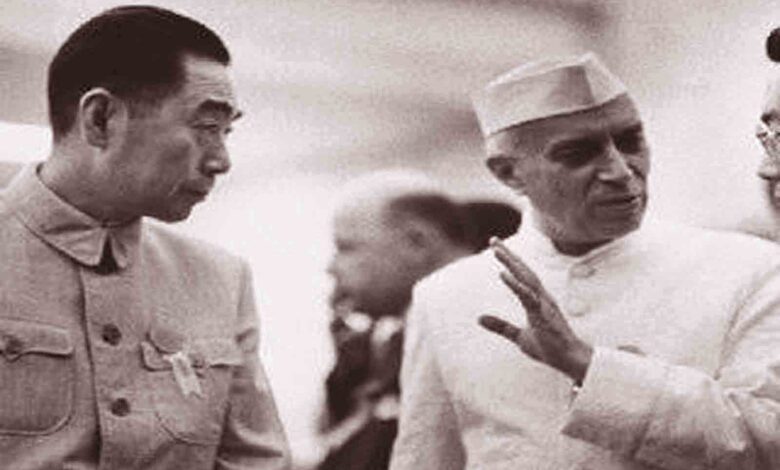
In 1956, then Prime Minister, Zhou Enlai visited India. The Dalai Lama accompanied him as a member of the official delegation. He told Nehru that the conditions were so harsh in his country that he wished to flee to India. Nehru advised him to return.To see the developing situation in Tibet for himself, Nehru communicated his wish to the Chinese government to visit Tibet in 1958, but he was refused.
The bilateral relation took a turn for the worse as a revolt broke out in Tibet in 1959. The rebellion was put down and the Dalai Lama fled Tibet and came to India, seeking asylum. Nehru kept on hesitating on providing the monk-king from Tibet official asylum, as he believed that China would consider it as an unfriendly act and retaliate. But Indira Gandhi was firm that India was morally bound to provide asylum to the Dalai Lama and others who had accompanied him to India.
As apprehended, sporadic border skirmishes began the same year the Dalai Lama arrived in India. Though Nehru was still convinced that a full-fledged war was most unlikely, he opted for a step to protect the interests of India which the Chinese dispensation had least expected. He was persuaded by a trusted Intelligence official, B N Mullick to sanction the provocative line known as ‘Forward Posts’: posting detachments at areas along the border which were being claimed by both sides. The ‘Forward Posts’ policy simply meant pushing Indian posts stealthily forward.
Zhou Enlai came again in 1960 to persuade India to refrain from such provocative acts. He suggested a way-out: India should connive with the Chinese border incursions along the western sector of the McMahon Line while China would gloss over India’s penetration along the eastern sector of the disputed frontiers. Nehru was supposed to be somehow open to the ‘pragmatic’ proposal, but the public opinion which had turned belligerently anti-China prevented him from advancing with Zhou Enlai’s proposal.
Clashes broke out in July 1962 between the two troops along the western sector. These were followed by the same on the eastern borders. The Crops Commander of Crops-IV – raised to encounter the Chinese challenge-Umrao Singh received command from Nehru to ‘throw out’ the Chinese in September 1962. Singh pleaded for a period of six months to gear up sufficiently for the offensive as the equipment at his disposal at that point of time was not deemed to be enough. Nehru rejected the plea and replaced Singh with B M Kaul. An expert on Sino-Tibet relations, Claude Arpi wrote that the intelligence inputs provided to the government had turned out to be a bad joke. The Chinese troops plunged into a major military strike in October 1962.
TheChineseChairman, Mao Zedong said on October 6 while addressing several senior Chinese generals in Beijing: “Since Nehru sticks his head out and insists on us fighting him, for us not to fight with him would not be proper.”
The Indian troops gallantly resisted the Chinese incursion on the western borders, but they were overwhelmed on the eastern frontiers. The Chinese fought with automatic weapons while the Indians had only outmoded 303 in which each shot was to be loaded separately. The jawans even did not have blankets against the blistering cold. The ground forces were exposed to enemy fire without air-cover because the Air Force was kept out.
Then Air Chief Marshal, N A K Browne later said lamentingly that the politico-military leadership under Nehru had committed a blunder in not using the Air Force in the operation.
The Chinese swept simultaneously through all the sectors: Tawang and Walong in North- East Frontier Agency (Arunachal Pradesh) and Ladakh and also down to Brahmaputra Valley, reaching as far as Tezpur in Assam with Calcutta coming under the striking distance. Nehru expressed his sympathy and agony for the people of Assam in a tone that indicated that he was almost reconciled to Assam having been occupied and over-run by the Chinese. Assam reacted wrathfully with the people wondering whether the government of India would do anything to protect it from the Chinese aggression.
Chaos reigned in Tezpur. The district commissioner fled, leaving the people to fend for themselves. There was an acute food shortage. The people were terrified, helpless, insecure. As things seemed to be heading towards a disaster, Indira Gandhi decided to visit Tezpur, leaving Nehru horrified. She reached Tezpur by helicopter from Guwahati on November 22. Swarms of people surrounded her and expressed their agony. Interestingly, the same day, China decided to pull back. They unilaterally announced a ceasefire and withdrew from the areas they had occupied.
Many opined that the ceasefire was announced to save Nehru from further disgrace. The Chinese strategists believed that heckling Nehru too much would lead to his exit and in that case, the next Indian government would join the US-led world alliance.
Signs of the impending Chinese invasion were telltale all through. National stalwarts like Sardar Patel and Rajagopalachari aside from the Opposition Jan Sangh leaders had kept warning the country of such moves from the Communist China long before India faced the real threat.