
Beyond the spark: Fixing the coaching trap and India’s medical education divide

GUEST COLUMN
 Kripa Nautiyal
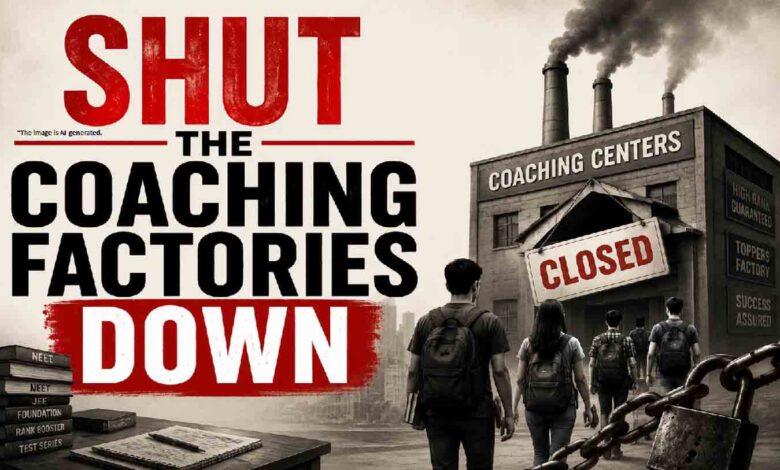
The scenes at Jantar Mantar this July, students holding blood-red placards, a Ladakhi engineer on hunger strike and an auto-rickshaw driver joining them in solidarity, were triggered by allegations surrounding the integrity of the NEET-UG examination process. But treating this merely as another examination controversy misses the larger picture. The frustration has been building for years, rooted in a deeper structural problem that governments have largely failed to address—the rapid growth of India’s private coaching industry, which has quietly evolved into the country’s “parallel education system”.
Industry estimates place India’s coaching and test-preparation market at around Rs 55,000–60,000 crore, covering NEET, JEE, UPSC, CAT and numerous other competitive examinations. In cities like Kota and Sikar, coaching has become the principal economic activity. Families often borrow or exhaust their savings to finance one or two years of intensive preparation. Premium residential coaching programmes can cost upwards of Rs five lakh, excluding accommodation and living expenses. The larger concern is its impact on school education. Numerous investigations have documented the widespread practice of “dummy schools” where students remain formally enrolled only to satisfy board examination requirements while their actual education takes place in coaching institutes. Schools become attendance providers rather than centres of learning, and students who cannot afford coaching begin the competition at a significant disadvantage.
Recognising these concerns, Assam and Rajasthan have enacted laws to regulate coaching institutes. Yet coaching organisations argue that these measures often burden small tuition centres while failing to address the real drivers of demand. Regulation alone, therefore, cannot solve the problem. Some suggest India should ban private coaching, as China attempted through its 2021 “Double Reduction” policy. China prohibited for-profit tutoring in core school subjects and expanded free after-school academic support in public schools. Official figures showed a dramatic decline in tutoring institutions. However, the demand for a competitive advantage did not disappear. Wealthier families shifted to expensive private tutoring, while many poorer students lost access to affordable coaching. Researchers have noted that although the reforms reduced academic pressure for many children, inequalities persisted because the highly competitive examination system itself remained unchanged.
India should learn from both the successes and limitations of the Chinese experience. Instead of attempting to eliminate coaching, the priority should be strengthening government schools through better teachers, laboratories, career guidance, structured doubt-clearing sessions and examination support integrated into regular schooling. Alongside this, governments can regulate coaching fees, advertising practices and refund policies. Coaching will cease to dominate only when public education offers comparable quality.
The other half of the problem
The coaching bottleneck feeds directly into another structural inequity— the affordability of medical education. India now has over 400 private medical colleges. Tuition fees vary widely but commonly range between Rs 40 lakh and well above Rs one crore for an MBBS course, while government institutions such as AIIMS remain highly subsidised. Even government-quota seats in private colleges often remain beyond the reach of many middle-class families, whereas management and NRI quota seats can exceed Rs one crore. As a result, many students who perform well in NEET but narrowly miss government college cut-offs effectively find medicine financially inaccessible unless they incur enormous debt. Access increasingly reflects economic capacity rather than merit alone. Many public health experts and student organisations argue that students from modest socio-economic backgrounds often possess a deeper understanding of underserved communities and may be more willing to serve in rural and remote areas, although this cannot be universally assumed. Regardless, financial circumstances should not determine who gets the opportunity to become a doctor.
India therefore needs a sustained expansion of government medical colleges, greater availability of subsidised or income-linked seats in private institutions, effective enforcement of fee regulations, and stronger scholarship and education-loan support.
What must be done
The long-term reforms outlined above will take time. The immediate crisis, however, is one of public confidence. First, there must be a transparent and time-bound investigation into allegations concerning examination integrity and administrative lapses, with findings made public and accountability clearly established. Students deserve confidence that future examinations will be fair and secure. Second, legitimate student concerns should not be dismissed as routine protests or law-and-order issues. Constructive engagement with students, parents and academic experts is essential to restore credibility and improve institutional accountability. Third, any remedial measures—whether revised evaluations, counselling adjustments, re-examinations or deadline extensions—must be implemented swiftly. For students preparing over several years, delays translate into lost opportunities.
Handled wisely, this moment could become the catalyst for long-overdue reforms in India’s examination and medical education systems. Mishandled, it risks becoming another controversy that fades from public attention while the underlying problems persist.
A balanced perspective
The coaching industry argues that it exists because many schools have failed to prepare students adequately for highly competitive examinations, and that excessive regulation could deprive students—especially those from smaller towns—of valuable academic support. Likewise, private medical colleges contend that their fee structures reflect the high costs of infrastructure, teaching hospitals and qualified faculty, warning that indiscriminate fee caps could discourage future investment and restrict the expansion of medical education. These concerns deserve consideration. The challenge is not to eliminate private participation but to ensure that commercial interests do not undermine equity and merit.
The students who protested at Jantar Mantar deserve to be heard because their concerns about examination integrity, transparency and affordability are genuine. Equally, however, this movement must not be allowed to become a vehicle for individuals, organisations or political parties seeking publicity or partisan advantage. Any attempt to divert a legitimate students’ movement towards political point-scoring weakens its credibility and delays meaningful reform. The focus must remain on restoring trust in the examination system, regulating the coaching ecosystem, making medical education more affordable and ensuring that every deserving student—irrespective of economic background—has a fair opportunity to pursue a medical career. The paper leak may have been the spark, but the deeper challenges lie in the coaching economy and the rising cost of medical education. Unless these structural issues are addressed with sincerity and foresight, today’s protests will not be the last—they will simply be another warning that India’s education system needs comprehensive reform.
(The author is an anthropologist and a retired additional director general of Indian Coast Guard; views expressed are personal)