Plan to form youth commission a concrete, positive step for Uttarakhand: Vidushi Nishank

INTERVIEW
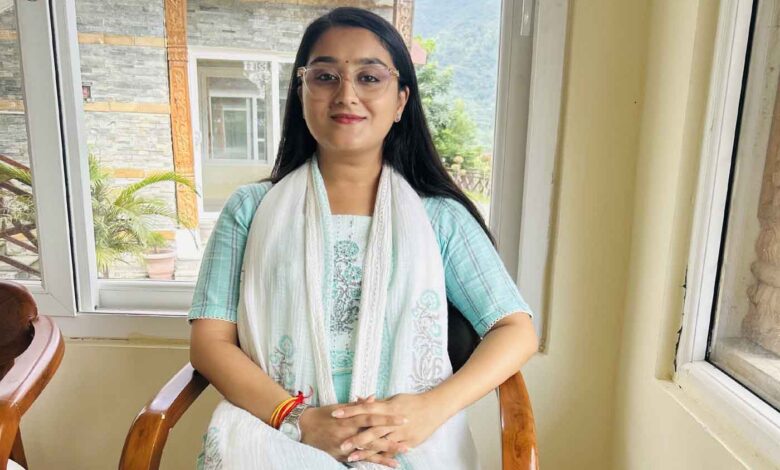
The director of Lekhak Gaon in Dehradun, social worker and daughter of former Union minister and ex-chief minister of Uttarakhand Ramesh Pokhriyal ‘Nishank’, Vidushi Nishank was among the first recipients of the Delhi Gaurav Samman 2026 for her contribution to education, justice, literature and social service. In an exclusive interaction with Mansi Bhambri of The Pioneer, she shared her views on her work and future plans.
What do you think were the reasons behind receiving the Delhi Gaurav Samman 2026?
I was informed about it for my contributions to social service, law and education. However, I believe that while everyone works for themselves, the true measure of an award lies in what you give back to society. A significant example would be the Kusum Kanta Foundation, which I started in honour of my late mother. During the Covid pandemic, we began distributing free rations to those in need. Our flagship merit scholarship programme has reached its sixth year and this year we are awarding a total of Rs 10 lakh in scholarships to 45-50 students from challenging backgrounds. We also provide training for women in skills like stitching and weaving, linking 400 women to job opportunities at Lekhak Gaon.
As a young woman from Uttarakhand whose work is centered on women and youth, what challenges have you faced and how did you navigate them?
In Dehradun, specifically in plain areas, while every woman is generally aware of opportunities, the main challenge lies in providing the right platform. Women know what they want to pursue and there are training opportunities available. However, skill alone doesn’t equate to empowerment. Our challenge was to ensure financial independence for women rather than simply providing ongoing support. We created direct platforms at Lekhak Gaon, where women can sell their products. Access to opportunities is a significant hurdle; various schemes exist for horticulture and creative industries but often fail to reach women. We strive to empower them and show that they don’t need to migrate to urban areas to earn a living. The challenge still remains and we are working on it.
What are lessons you learned from your parents growing up in the mountains and how have their values influenced your work and your approach to society?
People often assume we had a privileged life. Yes, we had access to education and opportunities for which I am grateful. But for us, privilege was never entitlement; it was responsibility.
I know my parents as ordinary persons with extraordinary passion. My father has struggled, became a writer and dedicated himself to serving the nation. My mother was an artist and a dedicated educator, who continued to teach even while battling cancer. We were raised with strong values, which greatly influenced our character and approach. And that is what I try to do – carry forward what I was taught by my parents.
Considering the strong opinions of youth and frequent protests, how do you think their energy could be channelled more constructively?
There is enough motivation among today’s youth, but they often lack direction. Their concerns, particularly seen in recent protests, are genuine. It’s essential to view their actions in context, recognising that issues often involve external influences. Today’s generation is actively engaged in discussions about politics, economy, and justice, which is positive. However, wisdom and direction come with experience. That will come when generations work together. All want a developed and equitable country, only perspectives differ.
Given your stated commitment to public service, do you ever see yourself entering politics for a larger impact?
Growing up, I observed public life closely, understanding what people need and expect. Initially, I distanced myself from politics due to the sacrifices I saw my father make for his public duties. However, I have come to realise that the joy of helping others far surpasses material possessions. Politics can be an effective means for enacting change. My father earned the trust of people, not things. I come from a family which taught us to think of others first. If I get an opportunity to serve through politics and carry forward this vision of progress with our culture and roots, then why not?
What are your views on the initiatives taken by the State government under chief minister Pushkar Singh Dhami for Uttarakhand’s development?
I see several positive and concrete steps being taken under chief minister Pushkar Singh Dhami’s leadership. The announcement that a youth commission will be formed is a particularly commendable initiative, providing a platform for youth to express their challenges and aspirations. This can help bridge the gap between their energy and the direction they need, ultimately contributing to a tailored approach for Uttarakhand’s growth and serving as a model for other States.