
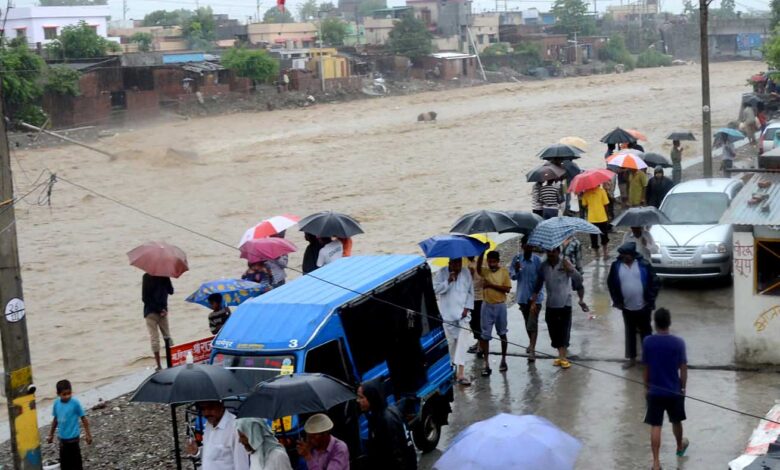

The ghost of 1988 flood revisited Gurdaspur and other 20 districts of Punjab this year. After 37 odd years, ripe old people remembered the trepidation to that nightmare. Himachal Pradesh and Uttarakhand in the western Himalayas remained next to Punjab in this list. The Prime Minister Narendra Modi visited flood-hit States including Punjab, Himachal Pradesh and Uttarakhand to announce the relief package worth Rs 4,300 crore. The flood and its destruction were reported from some other States as well. In this Assembly elections of Bihar, flood is one of major issues, in addition to drought that affected at least 10 districts. Large scale destructive floods in different parts of the nation was an issue also in the monsoon session of the Parliament. The disaster management teams of States and the Centre tried hard to save the precious lives during the floods this year too. Life in the relief camps was a reality in most of the flooded regions. Haphazard urban sprawl with uncontrolled use of concrete in structures, pavers and blocked drainage systems are the crises in town planning becoming a part of the public discourse as a ritual these days. The failure of planning norms and master plans in its implementation at various levels as reflected in the repetition of destructive floods is an outcome of the lack of critical attention.
The 74th Constitutional Amendment (1992) mandates the establishment of planning bodies such as the District Planning Committee (DPC) under Article 243 ZD and the Metropolitan Planning Committee (MPC) under Article 243 ZE. It also empowers municipal bodies through Article 243 W, read with the 12th Schedule, to perform functions like “urban planning including town planning” and to implement town planning schemes, local area plans and development plans as assigned by State legislation. Thus, there are constitutional mandates for planning institutions and functions.
However, the creation of a town planning cadre—that is, the service structure and recruitment of professional planners—is not constitutionally mandated; it must rest on a statutory basis through State laws, service rules, or administrative orders.
The Department of Expenditure, Ministry of Finance introduced the Special Assistance to the provinces for Capital Investment scheme with an allocation of Rs 6,000 crore in 2022–23 and Rs 15,000 crore in 2023–24. Within this scheme, the ‘Urban Reforms’ component is overseen by the Ministry of Housing and Urban Affairs. Many flagship government programmes involving crores in expenditure—such as the AMRUT GIS-based Master Plans, Local Area Plans (LAPs), Town Planning Schemes (TPS), and the River City Alliance’s Urban River Management Plans (RCA-URMPs)—demand robust town planning capacities at every level of the Urban Local Bodies (ULBs), State departments and Central agencies. These initiatives require professional planners equipped with modern GIS tools and multi-disciplinary expertise to guide India’s rapidly urbanising landscape.
Yet the recruitment frameworks being recently notified for filling permanent town planning positions reveals critical shortcomings that undermine both the profession and the very goals of urban development.
Broken hierarchy of posts: While multiple levels of posts—Chief Town Planner, Town Planner, Associate Town Planner, and Executive Town Planner—have long been created on paper, recruitment has been limited only to the Assistant Town Planners, for example as in Jharkhand. Senior positions remain vacant across the states, depriving the ULBs of leadership and leaving long-term planning projects without required oversight and expertise.
Narrow eligibility criteria in multi-disciplinary field: The eligibility conditions need to recognise graduates in Town Planning, Architecture, Civil Engineering with a Master’s in Planning, also including professionals from allied disciplines such as Geography, Economics, Sociology and Statistics as recognized by the Institute of Town Planners, India. Even within the recognised streams, the importance of Architecture graduates with planning specialisation and those with GIS and remote sensing expertise cannot be overstated. In today’s era of rapidly advancing technology and the dawn of AI-driven urban analytics, GIS skills are no longer optional—they are indispensable. By narrowing the pool, the recruitment ignores the very diversity that modern planning requires.
Lack of transparency in contractual hiring: The contractual positions for the planners are being advertised on several recognised government portals. In most of them transparency is missing. There are certain unanswered questions such as how are these candidates shortlisted, interviewed, and selected? In absence of the publicly available selection data, such processes risk undermining credibility and fairness.
State of contractual town planners: Another critical question here is why experienced contractual planners, who have already been serving at State level and Central government projects in the contractual roles for years, are not being absorbed into permanent roles through lateral entry mechanisms. The senior bureaucrats from other services are often laterally inducted into ministries on the basis of domain experience. Why, then, is the same principle not applied to the urban planners, who have worked tirelessly on government programs like AMRUT master plans, LAPs, TPS, PMAY-U, NMCG programmes and the urban river management plans?
Ignoring this experienced talent pool is especially damaging at a juncture when the cities face floods and unhealthy, unclean, and haphazard growth jeopardising the water bodies and biodiversity, while the urban fringe expands into villages, tribal areas, and forest zones, threatening both social and ecological balance.
Selection process detached from reality: Several recruitments in the past like in the case of Assistant Town Planner advertisement issued in 2020—overlooked weightage for work experience. As a result, a fresh graduate could be ranked at par with, or even above, a planner who has spent years delivering critical projects for the government. This disconnect between experience and evaluation ultimately weakens the very schemes that depend on specialised expertise—such as GIS-based planning, river rejuvenation, urban housing and integrated transport—placing their outcomes at serious risk. As such the selection process seems to be detached from reality.
Undermining the value of higher education: In fact, town planning is a profession that demands both academic rigor and practical exposure. If marks and weightage for evaluation criteria are not aligned with town planning qualifications and experience in the field, then what is the purpose of investing time, money and efforts into higher education in planning? If the advanced study and years of experience are ignored or demeaned, the recruitment rules risk discouraging young professionals from entering this vital field altogether.
In essence, urban planning is not just another administrative function—it is the foundation for sustainable, equitable and resilient cities. Unless recruitment policies are reformed to recognise the multi-disciplinary backgrounds, reward experience, qualifications and ensure transparency, India’s ambitious urban development agenda may falter under the weight of its own flawed systems. The ritual of raising a finger at the town planners cannot settle the repetition of floods so long as these burning issues are not addressed appropriately and timely.
(Jha is an architect and town planner, Kishore is an activist, author and columnist; views expressed are personal)