
IIT Roorkee develops sustainable method to convert renewable alcohols into high-value chemicals

PIONEER EDGE NEWS SERVICE/Haridwar
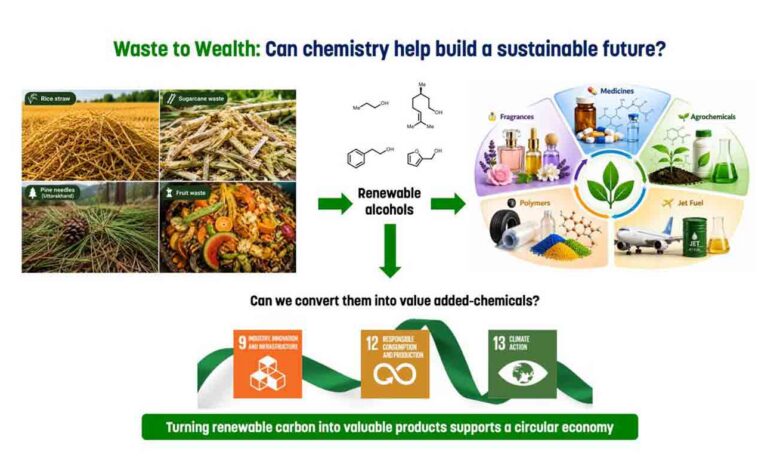
Researchers at the Indian Institute of Technology (IIT) Roorkee have developed a sustainable catalytic method for converting renewable alcohols into complex organic molecules used as building blocks in pharmaceuticals and advanced materials.
The institute claimed that the research published in the Nature Communications journal demonstrates the use of an earth-abundant nickel catalyst to produce trisubstituted olefins and 1,3-dienes with high selectivity, providing a new pathway for cleaner pharmaceutical and materials synthesis. According to officials, the study led by the institute’s chemistry department introduces a ligand-enabled nickel catalytic process. It efficiently converts biomass-derived alcohols into two classes of industrially important building blocks widely used in drug development and advanced organic materials. The IIT Roorkee team has developed a modular and efficient approach using a commercially available, earth-abundant nickel catalyst. The process achieves high stereoselectivity while utilising renewable alcohols as sustainable feedstocks. The team also demonstrated the versatility of the methodology through the late-stage functionalisation of biologically relevant molecules.
IIT Roorkee director KK Pant said that fundamental research in chemistry plays a vital role in enabling cleaner and more sustainable technologies. “The publication reflects IIT Roorkee’s commitment to advancing high-quality research that addresses global scientific challenges while contributing to the future of sustainable chemical synthesis,” he said.
The research aligns with the global transition toward green chemistry, focusing on renewable feedstocks, energy-efficient processes, and reduced chemical waste.