
Hillbilly
 Lokesh Ohri
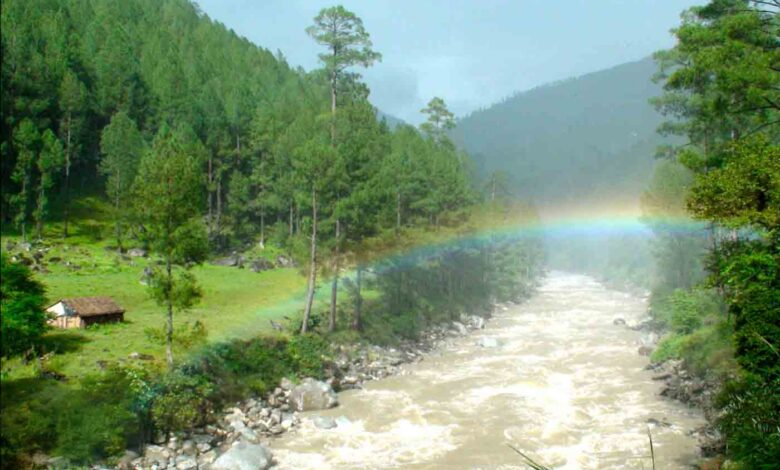
River Yamuna is one of the most sacred rivers of India. The river has been celebrated as an aquatic form of divinity for thousands of years. It is this reverence for nature that has helped us tide over several ecological crisis. Tracing a 1370 km journey, covering the states of Uttarakhand, Himachal Pradesh, Haryana, Delhi, Uttar Pradesh, the river originates from Yamunotri, and this is where we go today. From the term Yamunanjana, or the collyrium from the Yamuna country, occurring in the Atharva Veda (IV.9.10), it appears that the region drained by this river was known as Yamuna or Yavan Pradesa.
The Yamunotri glacier is perched on the southern face of Mount Kalinda about 20,000 feet above sea level, in the Garhwal region. Ten km to the east, the majestic Bandarpoonch Massif looms above it. The glacier melts with the action of the river’s father, the sun, producing a life-giving stream, the Yamuna. This stream fills the icy lake of Saptarishi Kund located at the glacier’s base. As the water gushes out of the lower end of Saptarishi Kund, it spills down the dark southern slope of Kalinda Mountain, forming a series of white cascading waterfalls and dropping a distance of more than 8,000 feet into Yamunotri, the source of the Yamuna. Here, at an elevation of around 11,000
feet, it joins boiling water bubbling forth from hot springs, another source of the Yamuna. Yamunotri is located on the Himalayan boundary between the Indo-Australian and Eurasian lithospheric plates, where magmatic heat wells up from the earth’s mantle. Natural wells and springs have been worshipped worldwide as both purifiers and transmitters of spiritual power, and they have been viewed as beneficial places at which to find a spiritual connect. The spiritual significance of the spot increases manifold when fire and water combine in a natural hot spring.
Local beliefs tell us that long ago, seven sages led by the great Jayamuni gathered at the place now known as Saptarishi Kund atop Kalinda Mountain, the mountain that had prayed to have the magnificent Yamuna to descend upon its head from its celestial abode. For many years the sages practiced severe asceticism at this remote site, seeking to bring the Yamuna down to benefit humankind. The story of the descent of the Yamuna is similar to that of the Ganga, except, Bhagirath brought the Ganga down for liberation of souls, post death, whereas Jayamuni and the other sages brought Yamuna down to earth to develop devotional insightor bhakti among the living. Some say that Kalinda implies a dark shade, because the southern face of this mountain is covered with dense vegetation, causing it to absorb the maximum amount of sunlight. Because Yamuna originates on Kalinda, she is also known as Kalindi.
The place where Yamuna descended from the snows, was a cold and isolated spot. Yamuna worried that very few people would be able to visit her at her source, and that those who did would experience great hardship. She prayed to her father, the sun, to make the location of her origin on earth more pleasant. In response, the sun gave her a gift: a single ray of solar splendour. He hurled this intense ray of brilliant light so that it struck a rock face on the east side of the canyon at the base of the long waterfall, causing boiling hot water to burst forth. Thus, the Yamuna has a dual source, a cold stream and a hot spring. The two meet and become one in the bowl of Yamunotri.
Yamuna also asked that whoever comes to her, bathes in her waters, and worships her at this spot will have a blessed life and will be spared the tortures of her brother, Yama, Lord of Death.
Today, many people visit and honour Yamuna at her origin. Thousands of pilgrims make the long trek up the steep slopes of the upper Yamuna valley to visit this natural shrine. Most pilgrims do so as part of the Char Dham Yatra.
The Yamunotri pilgrimage begins at Hanuman Chatti, located at an elevation of about 7,500 feet. A chatti is a resting place typically featuring tea stalls, shops selling necessary amenities, small outdoor restaurants, and even beds for those who plan to sleep there for the night. This one is called Hanuman Chatti because it is where the Yamuna absorbs a major mountain tributary called the Hanuman Ganga. Pilgrims leave Hanuman Chatti by crossing a bridge over the Hanuman Ganga and taking the foot trail that begins on the east side of the Yamuna. The first five km of the trail are carved into the wall of a wide gorge formed by centuries of rushing water. A few miles up the trail lies the first of the terraced farms that take advantage of the abundant water, and there is a small village consisting of houses with stone walls and thick thatched roofs. At this point the high snow-capped peaks to the north become visible. One can break the journey further at Janaki Chatti. During the peak season of late May and early June, the trail is lined with pilgrims from all social backgrounds and all walks of life. Regardless of how the traveller ascends the mountain, the trail offers magnificent views along the way, especially when one rounds the last bend and comes upon the Yamunotri complex and its stunning view of the glacier high above.
Across the river, on a plateau above its eastern bank, is the picturesque village of Kharsali, home of the Yamunotri priests. They spend the winter in stone houses covered by rough-hewn slate roofs supported by heavy wooden beams. Janaki Chatti stretches along the trail for almost a kilometre and a half. Above it, the trail becomes steep and passes through a thick stand of trees. Here the river roars loudly as it tumbles over huge boulders into waterfalls. Plumbeous redstarts, small dark birds with bright reddish brown tails and a white cap like patch on the head, jump from boulder to boulder in the swift stream, continuously fanning their tails up and down as if ready to leap into the air with each motion. The tree cover is dense along the rugged sides of the valley above Janaki Chatti. Himalayan Oaks and the evergreen Himalayan Yew cling to the steep walls of the ravine; black crows perched in their branches caw raucously. Misty rain often falls in this region, and the plentiful water supports a diverse range of vegetation. The oaks are covered with lush moss and bright green ferns; beneath them, bamboo, shrubs, and flowering plants thrive.
The final three km of the trail are arduous. After crossing another bridge over another roaring white tributary, the path shifts abruptly into a sharp ascent that consists of more than 50 switchbacks. These are necessary to climb the steep gorge, which rises several hundred yards between Janaki Chatti and Yamunotri. The trail in this section is frequently exposed, since it is carved into a vertical wall high above the riverbed. Clouds drift rapidly up the canyon, now concealing, and now revealing the snowy peaks looming ahead. Here the beauty of the Yamuna is breathtaking. She is wild, free, and crystal clear when heavy rains are not falling on the glacier high overhead. Finally, when it seems impossible to endure one more switchback, the hiker rounds the last bend and is rewarded with the spectacular view of the bowl of Yamunotri—the mouth of Yamuna.
This is the location of the temple complex and the destination of this pilgrimage. The white, frothy appearance of the falling water has led many visitors and local residents to compare it to a stream of flowing milk.
Some distance from the source of the hot spring, a few holy men have carved cave residences into this rock wall. Boiling hot water emerges directly from a fissure in the rock wall. As it spurts out of the rock, it makes a continuous gurgling sound. Many believe this is the voice of the sage Jayamuni, continually chanting the story of Kalindi or Yamuna’s glory. Immediately to the left of the Divya Shila is Surya Kund, the pond of the sun, built to hold some of the boiling water as it emerges from the fissure in the rock. Hot water flows from Surya Kund into another nearby tank, called Tapta Kund or the hot pond. Here, the water is mixed with enough water from the cold stream to make it agreeable for bathing. This is perhaps the most enjoyable of the effects of the sun’s gift to his daughter Yamuna- to soak in the water of this natural hot tub on a cool mountain day while gazing at the snow-covered peaks sparkling high overhead. Bathing in this water is considered one of the most powerful ways to take advantage of Yamuna’s blessings. There is a common saying along the banks of the Yamuna that where Yamuna is, there Yama or death is not. Yama occupies a prominent place in this pilgrimage and in the ritual actions performed at Yamunotri. Yet, the pilgrimage to Yamunotri is an effort towards achieving a peaceful meeting with Yamaraj, once the time comes to leave the earthly abode.
(The author is a writer, traveler and anthropologist who lives in the Himalaya; views expressed are personal)