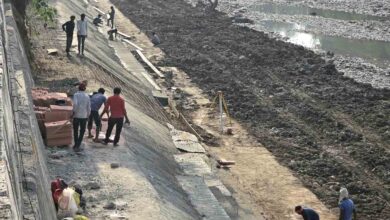


Wake-up calls disregarded, Nainital stares at greater disasters
Afzal Hussain Fauji / Nainital
September 18 is recorded as a black day in Nainital’s history, for 145 years ago, a devastating landslide occurred on this day, claiming the lives of 151 people. Even today, people shudder when they think of those horrific moments now all but buried in history. Yet, strangely enough, the catastrophe has failed to instil sense in the mind of the planners and the executors. The haphazard construction spree across the hill station has been going on unabated, threatening the town’s very existence. Landslides occurring all around is a grim warning, seeking to nudge all into corrective and preventive actions. But it seems that the wake- up call in the form of recurrent landslides is falling on deaf ears.
The town’s settlement began in 1841. The British began developing it as a resort. However, along with the settlement, the series of landslides continued. The rain that began on September 16, 1880, continued for two days, leaving a trail of destruction. After 889 mm rain recorded in two days, Alma Hill cracked. The landslides engulfed dozens of buildings, burying 151 people alive. Among those killed were 108 Indians and 43 British nationals. Many more were injured and left homeless.
The British administration was, however, prompt in rising up to the occasion. They made several arrangements to effectively stop recurrence of such calamities. These included restrictions on building construction and gardening in sensitive areas. They also drew up a rainwater drainage plan. Subsequently, 62 drains were constructed. Besides, a high-powered committee was constituted and it recommended and executed special regulations to protect the town from landslides. Following these regulations, Nainital was rebuilt in a planned manner.
Now, these rules have been relegated to oblivion with the race for urbanisation hell- bent on stripping the vulnerable town of the protective mechanism painstakingly built up by the then British administration. The drains, once considered the city’s arteries, have been choked, making the town staring at an impending disaster of massive magnitude.
In the 1990s, a GSI study divided the town into four zones. Geologists considered Zones 1 and 2 to be highly sensitive and recommended removing encroachments from them. The High Court also ordered the administration to remove encroachments from these areas. But these encroachments have not been touched yet, let alone razed down.
Experts said that the danger has deepened due to haphazard construction and non-treatment of previous landslide areas. They cited Baliyanala hill at the foot of the town experiencing landslides for years. The Mall Road has been deteriorating due to the mounting volume of vehicular traffic. The experts also mentioned the landslide that occurred three years ago at the town’s highest peak, China Peak, and the cracks found on the Tiffin Top hill point. Besides, land subsidence keeps recurring on Thandi Sadak and Raj Bhavan Road. They called upon the administration to wake up following the footsteps of the then British administration without waiting for a monumental catastrophe to befall the ecologically sensitive hill station.
Old landslide history of Nainital
• In 1866, a massive landslide occurred on Alma Hill.
• In July, 1867, a massive landslide occurred in the Nainital Club area.
• On 21 June, 1888, a landslide above CRST damaged the science laboratories followed by landslides on Raj Bhavan Road and Thandi Sadak.
• In 1924, massive landslide hit Ayarpata area
• On August 28, 1988, the Naina Peak and China Peak rocks collapsed.
• In 1988 and 1987, landslides at China Peak uprooted 100 trees, damaged 61 buildings and affected 470 families.