

HILLBILLY
 Lokesh Ohri
Today, let me take you to Haridwar, at Kankhal, where perhaps the most significant incident of Indian mythology occurred. This is the legend of Daksha. The story appears in the Mahabharata and is an important myth for both Shaivas, believers in Shiva, and Shaktas, believers in the female energy, the devi. The key events of this myth remain the affront to Shiva, the son-in-law, at Daksha’s sacrifice, Sati, his wife’s insistence upon going to her father’s yajna, her consequent self-immolation at the insult and the reinstatement of Daksha’s sacrifice. The site identified as the locus of these events is the temple of Daksha Prajapati, located about six kilometres South of Har-ki-Paidi, in Kankhal.
Daksha was the son of Brahma, the creator, and he carried out much of the work of creation himself and grew very powerful. Although he gave his daughter Sati to be Shiva’s wife, he was a proud man and felt contempt for Shiva since the latter was a wandering yogi who lived on alms, smoked hashish, had no home, no money, no family and engaged ghosts and goblins as his retainers. Once, Daksha performed a great sacrifice to which he invited all the gods. But as a deliberate insult, he did not invite Lord Shiva. The news of the sacrifice travelled all over the world and when Sati heard about it, she too wanted to be a part of it, especially since it was her father who would preside over the event. Shiva tried to dissuade her by telling her that to show up uninvited would be a blow to their dignity. But Sati remained obstinate and in the end, Shiva let her go. He sent her off on his mount Nandi, with a few of his retainers as escort.
When Sati arrived at the sacrifice, she found no place reserved for her husband. When she asked about this, Daksha responded by insulting her and her husband before the whole assembly. Sati was furious. She sat in simhasan, a yogic sitting posture, focused her mind on Shiva, and a fire erupted from her navel, that completely destroyed her body. Her escort party tried to dissuade her but Sati was adamant. They finally returned to Mount Kailas, to Shiva with the terrible news.
When Shiva heard of Sati’s immolation, he was so furious that he tore a matted lock of his hair or jata from each side of his head and dashed them to the ground. One of these became Virbhadra, the other became Mahakali, both fierce and destructive powers. At Shiva’s behest, they devastated Daksha’s sacrifice, killed or injured the guests, and beheaded Daksha. The conflict ended when the gods placated Shiva by rushing to him and entreating upon him to stop the destruction. Through Shiva’s grace, Daksha was restored to life, his head replaced with that of a goat, and the sacrifice was accomplished. But as a lesson to Daksha, Shiva decreed that even though the place would bear Daksha’s name, the worship there would be offered to Shiva alone.
Stressing devotion to Shiva, this myth establishes the Mayapuri region’s sanctity. Haridwar has traditionally been known as Mayapuri. The term maya has multiple meanings in Indian philosophies depending on the context. In later Vedic texts, maya connotes magic, an illusion where things appear to be present but are not what they seem, the principle which shows the attribute-less absolute as having attributes.Maya also connotes that which is constantly changing and thus is spiritually unreal, in opposition to an unchanging Absolute, or Brahman, and therefore conceals the true character of spiritual reality. According to Advaita Vedanta, maya, appearance,is the powerful force that creates the cosmic illusion that the phenomenal world is real.In this non-dualist school, maya at the individual level appears as the lack of knowledge or avidya of the real self, the Atman-Brahman, mistakenly being identified with the body-mind complex and its entanglements.
In Buddhist philosophy, maya is one of twenty subsidiary, unwholesome mental factors, responsible for deceit or concealment about the illusionary nature of things. In Vaishnavism, maya is an epithet, or a manifestation of the Hindu goddess Lakshmi, who represents wealth and who, along with Vishnu, is revered as the personification of the Absolute.
At the end of the Shiva-Daksha myth, pleased by Daksha’s hymn of praise, Shiva asks him to choose a boon. Daksha said, “Grant that this place may become a crossing place or tirtha, destroying great sins.”
Shiva replied: This region will be extremely holy, where, through the operation of maya, you realised all. I shall dwell in this region under the name of Daksha’s lord, Daksheshwara. Just by seeing me one will acquire the eight supernatural powers, the siddhis. Those who prostrate only once in worship to Shiva Daksheshwara will become equal to Shiva’s retainers, such as Nandi, Bhringi and so forth…
Mayapurimahatmaya, 5.76-81
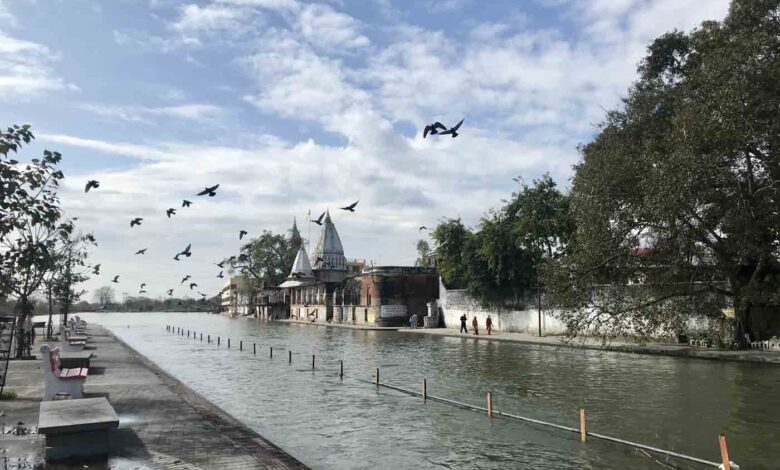
Kankhal, close to Daksha Prajapati temple, is primarily a cremation or shamshan ghat, adorned with several majestic structures from the 17th and 18th century. Many sites built in Rajput and Mughal architecture decorated with beautiful wall paintings can be seen here. Havelis of Raja Bharmal and the King of Patiala are the most fascinating out of all the buildings. Many Akharas also dot the landscape of Kankhal. According to Vayupuran, this is the place where Goddess Ganga tells Bhagirath that, “I am blessing the places I am flowing through, but as I am flowing through Kankhal, I am the one being blessed”. The cremation ground, where people congregate to immerse ashes of the dead is well known. The precinct is surrounded by Shri Panchayati Akhara, Bada Udasin Temple and Raj Ghat. Though the site is ancient, the pavilion itself was constructed in 1952. The mythical story associates Kankhal and Shamshan Ghat with Uma Devi or Sati. It is believed that a person achieves salvation if his cremation is performed at the bank of Ganga in Kankhal. The entrance is through a rectangular gate having a small shikhara, leading to an open court. It has sacred trees and places to sit. The main entrance gate has colonnades on either side, which is used as a waiting area. It has a flat roof with a series of square pillars supporting the structure. A rectangular, walled veranda is supported over rectangular pillars besides the riverside and is utilized for funeral rites. Stone paved steps lead up to the river.
Kankhal, in Haridwar, therefore emerges as the most significant site where the river Ganga grants solace and peace, not just to the living but also to the dead.
(The author is a writer, traveler and anthropologist who lives in the Himalaya; views expressed are personal)