Dhami seeks special policy support for Himalayan States in NITI Aayog meeting

PIONEER EDGE NEWS SERVICE/ Dehradun
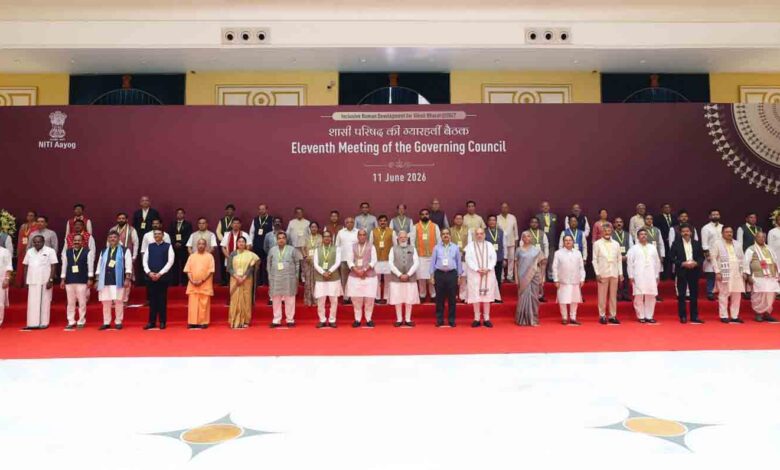
In the meeting of NITI Aayog held in New Delhi on Thursday, chief minister Pushkar Singh Dhami presented a roadmap for the development of Uttarakhand and emphasized on the need for special policy support and long-term financial arrangements for Himalayan states on issues related to climate change, ecological conservation and disaster management. The meeting was chaired by Prime Minister Narendra Modi.
The CM said that in sync with the resolution of Viksit Bharat -2047, the Uttarakhand government is placing special emphasis on human resource development, quality education, skill development, innovation, and youth empowerment.
Dhami said that India holds immense potential in areas such as artificial intelligence, robotics, cyber security, data science, and semiconductor technology. He stated that the State government is moving forward with the mantra of ‘Viksit Uttarakhand for Viksit Bharat’ and for this efforts have been made to develop Uttarakhand as a model of development by integrating agriculture, industry, tourism, energy and the service sector through more than 30 new policies over the past year.
Dhami averred that the State government is striving to develop sectors such as natural farming, horticulture, medicinal plants, Yoga and wellness, tourism and green energy as future growth engines. Work is also underway to develop Uttarakhand as a national model for a knowledge-based economy, wellness economy and sustainable development. He added that Uttarakhand is playing a significant role in the conservation, promotion and preservation of the country’s environmental and spiritual heritage. “The Himalayas, the Ganga, the Yamuna, and the vast forest areas are not only Uttarakhand’s heritage but also an invaluable asset to the entire nation. Therefore, considering specialized policy support and long-term financial arrangements for Himalayan states on issues related to climate change, ecological conservation, disaster management, carbon neutrality, green energy and mountain infrastructure development is a crucial need of the hour,’’ he said.
The CM added that Uttarakhand has also launched several important initiatives in the field of good governance and technological innovation.
Congratulating PM Modi on his record 12-year tenure, Dhami said that he has established a record of continuous service to the nation by receiving the longest mandate in the country’s democratic history. He invited the PM and all members of the NITI Aayog to attend the Kumbh Mela and Nanda Raj Jat Yatra, to be held in Uttarakhand next year.